Contents of the guide Show ▾
AdBlue is a urea solution used in the exhaust aftertreatment of many modern diesel motorhomes and converted vans. A warning light often starts as a low-level reminder, but it can escalate to a speed restriction and a start inhibit. This guide explains the difference between a low level and a system fault, what you can check yourself, and when you should go to a workshop. It is not a diagnosis of your particular vehicle. Follow the handbook.
The essentials at a glance
- AdBlue is a urea solution for the exhaust aftertreatment, not a fuel additive. Fill only the AdBlue tank.
- A light or a message comes in several stages: low level, a sharper warning, sometimes a speed restriction, and finally a start inhibit.
- A system fault is not the same as a low level. In that case, simply topping up will not help.
- AdBlue freezes at about −11 °C. The vehicle usually has heating when the engine is running; a container in the living area does not.
- If diesel and AdBlue have been mixed: do not start the engine. Contact a workshop.
- Do not disconnect the AdBlue or exhaust system. It is not permitted.
What AdBlue does in the motorhome
In vehicles with selective catalytic reduction (SCR), AdBlue is injected into the exhaust so that nitrogen oxides can be reduced. The system has its own tank, pump and sensors. A low level is dealt with by filling the right fluid in the right tank, according to the handbook. A quality problem, a frozen line, a faulty sensor or a dosing fault is a different matter and belongs in a workshop.
Typical symptoms: light, warning and start inhibit
Read the exact message in the display. Many vehicles warn in stages: first that the level is low, then that you should fill up before a remaining distance or a remaining number of starts is used up, and finally that starting will be prevented. A speed restriction can come in between. A message about a system fault, incorrect fluid, or a level that cannot be measured is not a simple low-level warning.
Why motorhomes and converted vans are affected more often
The motorhome or converted van often stands still for a long time at a stopover or in winter storage. Shorter trips between overnight stays give fewer long, warm drives. AdBlue that sits in the tank or in a container can age if it is stored for a long time, in heat or in an opened container, and a container in a cold living area can freeze. That is a typical pattern for a leisure vehicle, not because the system is different in principle from an everyday car.
Common causes
- Low level after a long period without topping up.
- Aged or poor-quality fluid, or fluid stored incorrectly.
- Freezing in a container or in a line after a cold standstill.
- A sensor, pump or dosing fault — a system fault, not a low level.
- Diesel and AdBlue mixed in the wrong tank.
Ducato/Multijet, Transit, Sprinter and Crafter
Details differ between model years and equipment. The handbook for your vehicle comes first. On all four the warning often comes in stages towards a start inhibit. If the injection system is at fault, go to a workshop – a countdown towards a start inhibit can follow then too. Diesel in the AdBlue tank can cause irreversible damage to the pump. If AdBlue has gone into the diesel tank: do not try to start, contact a workshop.
Fiat Ducato and Multijet
In Fiat’s Ducato owner handbook (English edition, July 2018), the first low-level warning comes at around 1,200 km of range left, and the light only goes out once at least 3 litres have been added. When the range reaches zero, the van cannot be restarted after switching off until you have topped up. More in our guide to common Fiat Ducato faults.
Ford Transit
According to Ford, the 2.0 EcoBlue that arrived in the Transit and Transit Custom in 2016 was the first engine with Ford’s standardised SCR system, so a Transit with that engine has AdBlue. Whether an older Transit has it depends on the engine and Euro class. Warning stages and quantities for the Transit are not repeated here; follow the handbook. More in our guide to common Ford Transit faults.
Mercedes Sprinter
Whether a Sprinter has AdBlue depends on the model year and Euro class. When the Euro 5 engines arrived in 2009, Mercedes wrote that the Sprinter met the limits without SCR. With the 2013 update, Mercedes said every engine variant met Euro VI using SCR with AdBlue. Follow the handbook for your van’s warnings and refill quantities. More in our guide to common Mercedes Sprinter faults.
VW Crafter
Warning stages and quantities for the Crafter are not repeated here; follow the vehicle’s handbook.
What you can do yourself — and what you should not do
These are checks and filling according to the handbook, not repairs of the aftertreatment.
- Read exactly what the display says. Distinguish a low level from a system fault.
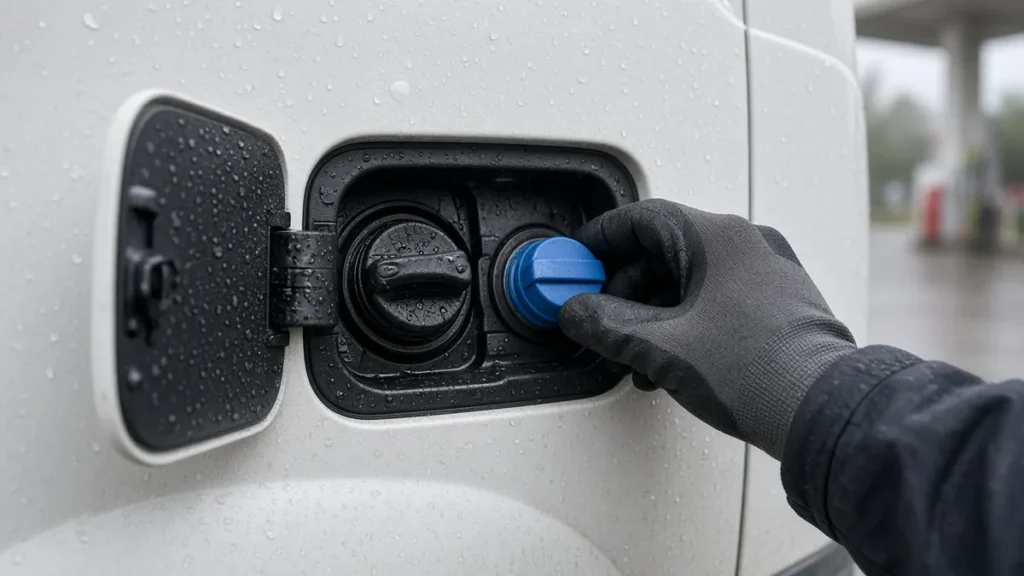
- Check that you are filling the AdBlue filler, not the diesel. The cap and the opening are marked, but they sometimes sit close together behind the same flap.
- Fill with sealed AdBlue of the quality the handbook requires, at least the quantity stated there. Do not fill above the maximum level.
- After filling an empty or almost empty tank: wait as long as the handbook says, with the ignition or the vehicle on according to the instructions, before you start or drive.
- Look for obvious spills, a loose cap or a damaged container. Rinse away spills with water.
- Store opened containers closed, cool and protected from the sun, according to the label. Do not leave them permanently in the vehicle.
- Look in the trip computer for the AdBlue level, if your model shows it.
Do not do this:
- Do not start the engine if diesel and AdBlue have been mixed. Leave the vehicle standing and get a workshop to drain and clean it.
- Do not add other fluids, and do not dilute with tap water.
- Do not disconnect the pump, sensors, lines or any other aftertreatment, and do not fit equipment that tricks the system.
- Do not rely on a “reset” in a device to solve the fault if the cause has not been put right.
- Do not dismantle the system, and do not work on brakes, steering or airbags on your own initiative.
Service and intervals for the base vehicle more generally are in the campervan service plan.
When you should go to a workshop
Go to a workshop, and do not try to repair the aftertreatment yourself, if any of this applies:
- The display talks about a system fault, incorrect fluid, or a level that cannot be measured — not only about a low level.
- You have a start inhibit, or a warning with few starts or a short distance left, and you are unsure of the cause.
- The warning does not clear after you have filled the right fluid, in the right tank, in the right quantity, and waited the time the handbook states.
- The engine is in limp mode, or the engine warning light is flashing.
- You suspect a leak you cannot assess, or that diesel and AdBlue have been mixed — in that case do not start.
- The engine runs very unevenly, there is unusual smoke, or you hear a noise that does not match the brief click or the brief pump run after shutdown that some handbooks describe as normal.
A workshop with diagnostic equipment for your make can read the code and check dosing, sensors and quality. You can look the code up in Camperliv’s fault-code tool.
It is not permitted to disconnect, switch off, trick or otherwise tamper with the exhaust aftertreatment, including the AdBlue system. Do not do that, and do not ask anyone else to do it. The owner of the vehicle must maintain it so that the emissions requirements are met. The aftertreatment, including the AdBlue system, must be left intact regardless of type approval and mass. See the Swedish Exhaust Emissions Cleaning Act (2011:318).
Frequently asked questions
What does the AdBlue warning in the motorhome mean?
Often that the level is low and that you should top up according to the handbook. It can also be a system fault. Read the exact message. Filling only helps if the problem is a low level.
Can the motorhome refuse to start if I do not fill AdBlue?
Yes. Many vehicles count down towards a start inhibit if you ignore the warning. Follow the handbook and do not wait until the last start.
Why do I get an AdBlue fault after the vehicle has stood still for a long time?
Fluid can age, and in cold weather it can freeze in a container or in a line. After winter storage, check the level and the condition of any container before you start a longer trip.
Can I fill AdBlue myself?
Yes, if it is a matter of topping up the right fluid in the right tank according to the handbook. A system fault, mixed fluids or a warning that does not clear after filling belongs in a workshop.
Are AdBlue faults common on the Fiat Ducato?
They occur, as on other modern diesel base vehicles, especially after a long standstill or if the warning is ignored. Follow the handbook for your model year; this is not a diagnosis of a particular Ducato.
When should I go to a workshop for an AdBlue fault?
If the message is about a system fault, if a start inhibit is close or active, if the warning does not clear after a correct fill, if the engine warning light is flashing, or if fluids have been mixed.
Sources
- Yara Sweden, “AdBlue for commercial vehicles”: yara.se
- The vehicle’s own handbook, which always comes first for filling, waiting times and warnings.
- Exhaust Emissions Cleaning Act (2011:318), up to SFS 2022:1124.
- Fiat Ducato Owner Handbook, official English edition, July 2018, PDF from Fiat Aftersales (document 603.91.341)
- Ford of Europe: “All-New Ford EcoBlue Engine is Diesel Game Changer”, 26 April 2016 (media.ford.com, read via the Internet Archive)
- Mercedes-Benz/Daimler Communications: press kit on the OM 651 in the Sprinter, May 2009 (media.mercedes-benz.fr, PDF, French)
- Mercedes-Benz: press information on the updated Sprinter with Euro VI, 2013 (media.mercedes-benz.fr, French)
The guides in this section do not replace an assessment in a workshop. Use the fault-code tool as a way into the right system, not as a finished diagnosis. See also the particulate filter, EGR valve and mechanical section.
New checklists and guides, plus reminders before winter storage and inspection. A few emails a year, nothing more.
The content is based on my own experience and the rules that applied when the text was written. Rules can change, and I am not responsible for factual errors or rule changes that affect your build or maintenance. Read the full disclaimer.

Linus Thell
Founder of Camperliv.se. Has worked with vehicles for essentially all of his adult life.
Read more about Linus →