Contents of the guide Show ▾
The turbo gives a diesel motorhome or converted van more air, and therefore more power, especially on hills and with a heavy load. When the boost pressure is not right, pulling power can drop, a warning light can come on, or an abnormal noise can be heard. This guide explains how the turbo and boost pressure work, typical symptoms and causes, and when you should go to a workshop. It is not a diagnosis of your particular vehicle.
The essentials at a glance
- The turbo uses exhaust flow to push more air into the engine.
- Low boost can come from leaking hoses, a control fault, a blocked exhaust system — or a faulty turbo. The cause is not automatically a broken turbo.
- Fault code P0299 points specifically towards too little boost pressure.
- A sudden loss of power, a loud abnormal noise, unusual smoke or a suspected oil leak belongs in a workshop.
- Do not dismantle a hot turbo, and do not drive on as usual if the engine is in limp mode or the engine warning light is flashing.
How the turbo and boost pressure work
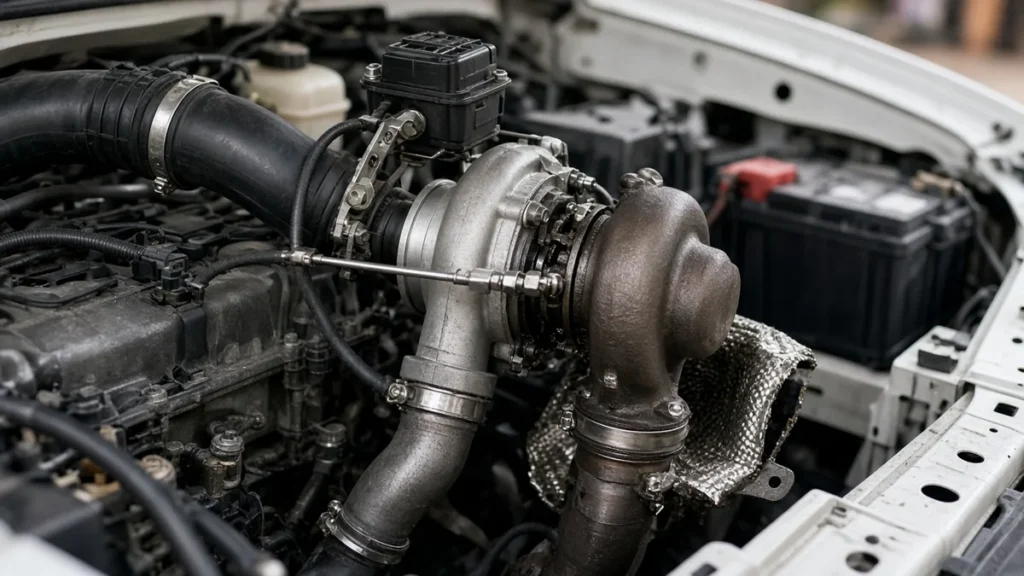
Exhaust gases drive a turbine, which drives a compressor that pushes more air into the engine. Pipes and hoses between the turbo, the intercooler and the intake must be tight. A wastegate or a similar control regulates the boost. If air leaks out, if the control does not work, or if the exhaust side is restricted, the boost can be too low or too high.
Symptoms
- Poor pulling power, especially on hills or with a heavy vehicle.
- An engine warning light, sometimes limp mode.
- An abnormal whistle, siren-like noise or grinding.
- Unusual smoke.
- Fault code P0299, or other codes that point towards boost pressure.
Common causes
- Cracked, oily or loose hoses between the turbo, the intercooler and the intake.
- A fault in the boost control (for example the wastegate or its actuator).
- A restricted exhaust system, including a blocked particulate filter.
- A fault in the turbo itself.
Low boost is not automatically a broken turbo. A workshop can distinguish a hose leak from a mechanical fault.
Motorhomes and converted vans: load, hills and short journeys
A heavy motorhome on a hill asks more of the turbo than a lightly laden everyday car. Short journeys in which the engine never gets properly warm, followed by an immediate shutdown after a hard climb, are more demanding. That does not in itself prove a fault, but it is a reason to follow the handbook’s instructions on warming up and shutting down.
Ducato/Multijet, Transit, Sprinter and Crafter
Fiat Ducato and Multijet
The official English Fiat Ducato owner’s handbooks (Fiat Aftersales) warn against a rapid throttle input just before switching off – it serves no purpose, wastes fuel and is particularly harmful to turbo engines. They also say to drive away gently while the engine is cold, and to let the engine idle for a while after demanding driving before you switch off. More in our guide to common Fiat Ducato faults.
Ford Transit
When Ford presented the 2.0 EcoBlue in 2016, it described a low-inertia turbo with a new geared actuator that halved response times. Follow the handbook for your van. Known faults on the Transit are covered in our guide to common Ford Transit faults.
Mercedes Sprinter
According to Mercedes’ 2009 material, the OM651 in the Sprinter has a variable-geometry turbo in the 95 hp base version. The 129 and 163 hp versions have a two-stage system: a small high-pressure turbo handles boost at low revs, and a larger low-pressure turbo takes over from mid-range. Both have a bypass valve to protect against overboost. The official Sprinter handbook opened for other guides in this section has no owner’s section on troubleshooting boost. More in our guide to common Mercedes Sprinter faults.
VW Crafter
Exact figures for the Crafter are not repeated here; follow the vehicle’s own handbook.
Fault codes that often belong to the turbo
P0299 points towards too little boost pressure. Other codes can belong to the same system. P0238 is often mentioned together with the boost-pressure sensor and is taken into the tool at a later step. P0234 and P2263 can also point towards boost that is outside what is expected, for example too high or implausible. Look codes up in the fault-code tool. They are not a diagnosis of your vehicle.
When you should go to a workshop
- A sudden loss of power, limp mode, or a flashing engine warning light.
- A loud abnormal noise, unusual smoke, or a suspected oil leak into the intake or the exhaust.
- Fault code P0299 comes back, or you are unsure after reading the code.
Do not try to drive on as usual in those situations.
Frequently asked questions
What symptoms does a turbo fault give in the motorhome?
Often poor pulling power, an engine warning light, an abnormal noise or unusual smoke. The same symptoms can have other causes, including leaking hoses or a blocked exhaust system.
What does fault code P0299 mean?
It points towards too little boost pressure. The cause can be a leak, a control fault, a restriction in the exhaust or a fault in the turbo. More in the P0299 guide.
Can low boost be due to something other than a broken turbo?
Yes. Leaking hoses, a control fault or a blocked particulate filter can give the same code. That is why the cause should be assessed in a workshop.
Are turbo faults common on the Ducato, Transit or Sprinter?
They occur on turbo diesel base vehicles, especially if hoses or the control are neglected, but this is not a diagnosis of a particular model. Follow the handbook.
What can I check myself before going to a workshop?
With the engine switched off and cool, you can look for cracked, oily or loose hoses between the turbo, the intercooler and the intake. Note any abnormal noise and the exact fault code. Do not loosen hot parts, and do not dismantle the turbo.
When should I go to a workshop for a suspected turbo fault?
If there is a sudden loss of power, limp mode, a flashing engine warning light, a loud abnormal noise, unusual smoke or a suspected oil leak to the intake or the exhaust. Do not try to drive on as usual in those situations.
Sources
The driving instructions on warming up and shutting down are based on sources opened on 11–12 November 2026. The descriptions of function and codes are in our own words. The owner’s handbooks that were opened have no troubleshooting section of their own for P0299 or the wastegate.
- Fiat Ducato Owner Handbook, official English edition, July 2018, PDF from Fiat Aftersales (document 603.91.341): warning that a rapid throttle input before the engine is switched off serves no purpose, wastes fuel and is particularly harmful to turbo engines.
- Fiat Ducato Owner Handbook, official English edition, May 2011, PDF from Fiat Aftersales (document 603.81.947): drive away gently and without harsh throttle inputs while the engine is cold (particularly harmful to a turbo); after demanding driving, let the engine idle for a while before you switch off; the same warning about a rapid throttle input before shutdown.
- Ford of Europe: “All-New Ford EcoBlue Engine is Diesel Game Changer”, 26 April 2016 (media.ford.com, read via the Internet Archive)
- Mercedes-Benz/Daimler Communications: press kit on the OM 651 in the Sprinter, May 2009 (media.mercedes-benz.fr, PDF, French)
The Exhaust Emissions Cleaning Act (2011:318) is not used here as support for a particular turbo paragraph. The rest of the aftertreatment is covered in the guides to the particulate filter, EGR and AdBlue. No prices are given; the source material has no sourced cost figures.
See also the mechanical section.
New checklists and guides, plus reminders before winter storage and inspection. A few emails a year, nothing more.
The content is based on my own experience and the rules that applied when the text was written. Rules can change, and I am not responsible for factual errors or rule changes that affect your build or maintenance. Read the full disclaimer.

Linus Thell
Founder of Camperliv.se. Has worked with vehicles for essentially all of his adult life.
Read more about Linus →