Contents of the guide Show ▾
Passenger car class 2 (class II) is the Swedish Transport Agency’s designation for a motorhome: a passenger car that is permanently fitted out as living accommodation. Approval requires permanently fitted seats, sleeping places, equipment for cooking and storage, and a table, plus an approved registration inspection. Download the PDF checklist: print it and tick off the ten steps before the registration inspection.
The essentials at a glance
- Passenger car class II is a passenger car permanently fitted out as a home. A motorhome can also be registered as a lorry, with different rules.
- Four items must be in place: permanently fitted seats, sleeping places, cooking and storage equipment, and a table.
- A converted panel van needs a registration inspection, with a written account of the changes, within one month (or within one week after a lay-up ends).
- A category B licence covers a maximum authorised mass of 3,500 kg, unless the licence was obtained before 1 July 1996 and has not been withdrawn since.
- There is no special speed limit. Since 1 February 2025, motorhomes (passenger car class II) are not covered by malus (the raised vehicle tax in the first years).
- I do not quote inspection prices here — they are set by each inspection company. Ask what is included when you book.
What is passenger car class 2 (passenger car class II)?
Passenger car class 2 is officially written passenger car class II, and is sometimes called pb2, motorhome class 2 or a class 2 vehicle. The Swedish Transport Agency describes it as follows: a passenger car class II is permanently fitted with a body arranged as living accommodation and equipped with at least permanently fitted seats, sleeping places, equipment for cooking and storage, and a table.
What does that mean in practice?
It is not enough that you sometimes sleep in the vehicle — it must be built as living accommodation. At the same time, not all motorhomes are passenger cars: according to the Swedish Transport Agency a motorhome can also be registered as a lorry, and then different licence, equipment, tax and fee rules apply. See also the rules guide.
Motorhome class 2 or class 1 — what is the difference?
| Passenger car class 1 | Passenger car class 2 (motorhome) | Light lorry (truck) | |
|---|---|---|---|
| What is it? | An ordinary passenger car | A passenger car arranged as living accommodation | A lorry with a maximum authorised mass of no more than 3.5 tonnes |
| Interior requirements | No living-accommodation requirements | Permanently fitted seats and sleeping places, cooking and storage, and a table | No living-accommodation requirements |
Sources: Swedish Transport Agency, Passenger cars and the English vehicles overview.
The Swedish Transport Agency’s requirements — the four that must be in place
The body must be arranged as living accommodation and equipped with at least the following.
1. Permanently fitted seats
The seats must be fixed in place. The cab seats count, but a loose camping chair in the living area does not.
2. Permanently fitted sleeping places
The sleeping place must be permanently fitted and may, according to the Swedish Transport Agency, consist of seats that can be converted into sleeping places. A sofa that converts into a bed counts; an air mattress on the floor does not. More on sleeping places and layout in a campervan.
3. Permanently fitted equipment for cooking and storage
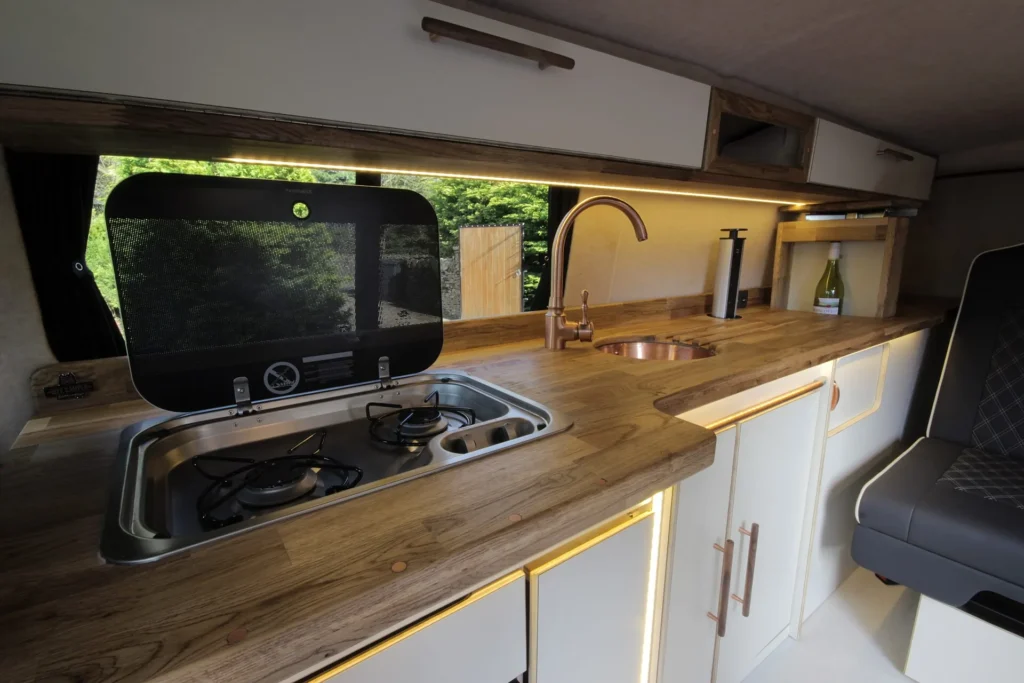
There must be a permanently fitted kitchen area with space to cook and to store kitchen utensils. More on LPG and cooking in a campervan. In my experience, a thought-through worktop with a fixed fridge signals “living accommodation” much more clearly than a hotplate and a portable cool box. If your solution is on the borderline, ask the station before you book.
4. A table
There must be a table. The wording of the rule says “table” without “permanently fitted” (see the FAQ). A fold-down table or a table on a removable pedestal usually works, as long as it belongs to the interior.
What the inspector looks at — dimensions and reasonableness
The Swedish Transport Agency’s text gives no dimensions — not for standing height, bed length or storage. What decides it is whether the vehicle is arranged as living accommodation, and that is a judgement. These are my experiences of what usually counts:
- The overall impression. A well-worked-through conversion usually goes smoothly. Something that looks provisional can fail even if all four points are present.
- A reasonable balance between seats and sleeping places. The numbers do not have to be equal, but the proportion should be reasonable.
- Fit-for-purpose storage for clothes, kitchen utensils and equipment. A single set of drawers is rarely enough.
- Standing height. Not a requirement in the wording of the rule, but a low roof can affect the overall impression. If you have a low vehicle, be ready to show that it works as living accommodation.
- The passage between the cab and the living area. Not a requirement, but questions may come if the living area is completely separated.
Because the interpretation can differ, my best advice is to call the station in advance and describe the conversion. For the size and mass of the base vehicle, see choosing a vehicle for a campervan conversion.
Weight and driving licence — the 3,500 kg limit
The maximum authorised mass in the registration certificate does not rise because you fit a conversion — everything you install uses up payload. With a category B licence the maximum authorised mass may be at most 3,500 kg. Weigh the finished vehicle and use the weight calculator. More in the guide to weight and axle loads and in the rules guide.
Which licence is required for a class 2 motorhome?
Category B covers a passenger car class II with a maximum authorised mass of 3,500 kg. A B licence obtained before 1 July 1996, if it has not been withdrawn after that date, entitles you to drive a passenger car over 3,500 kg. Heavier motorhomes otherwise need C1 (up to 7,500 kg). Sources: Swedish Transport Agency, driving licences (English).
Re-registering a light lorry as a passenger car class 2
Most panel vans that are converted are registered as a light lorry. Re-registering a light lorry as a motorhome means the vehicle type changes from lorry to passenger car — you therefore re-register the light lorry as a passenger car class II at a registration inspection.
What changes
When you re-register a light lorry as a motorhome, the vehicle type in the road traffic register changes. The driving licence, tax, insurance and inspection interval then follow passenger car class 2 instead of light lorry.
Costs and paperwork at a glance
| Item | What to bear in mind |
|---|---|
| Registration inspection (weighing, change of vehicle type) | Often not in the price list. Ask about the price and what is included when you book. |
| Retrofitted safety equipment (for example a swivel seat, belt anchorages) | Bring documentation that the requirements are met, for example a certificate of conformity. |
| Vehicle tax after re-registration | Calculated by the Swedish Transport Agency — see the tax section below. |
Converting a panel van into a motorhome: the registration inspection step by step
When you have converted the panel van into a motorhome, the vehicle is assessed at a registration inspection. In practice it goes like this:
- Finish the conversion. The inspector assesses what is in the vehicle on the day.
- Call and book. Describe the conversion and say that it is a conversion to a motorhome. Book within the time limit.
- Prepare the papers. Registration certificate, ID, and a written account of the changes you have made. You must also provide documentation showing that the requirements are met — for example a certificate of conformity from the manufacturer for retrofitted or swivel seats and belt anchorages — unless the inspector can check it on the spot (TSFS 2010:87, see below).
- Inspection and weighing. The vehicle is weighed and checked against the requirements for passenger car class 2 and that the conversion is traffic-safe.
- The registration is changed. If it is approved, the change is entered in the road traffic register. If it fails, the vehicle must be inspected again within one month.
Extra or swivel seats
If you have fitted extra seats in the van, or changed to a swivel seat, that is a change that is inspected. Under the Swedish Transport Agency’s regulations, the person presenting the vehicle must provide information showing that the requirements on construction and equipment are met. That can, for example, be a certificate of conformity issued by the vehicle manufacturer, the component manufacturer or a technical service. The information is not needed if the inspector can see for themselves, by measuring, weighing or simpler checks, that the requirement is met — but for seats and belt anchorages that is rarely possible. Ask the station what documentation they want to see for your particular solution (TSFS 2010:87, Chapter 2, Sections 1–3 and 12–16).
Tick everything off in the registration inspection checklist. If you have LPG on board, read LPG in a campervan.
What does it cost to re-register as a motorhome?
The price is set by each inspection company and it changes, so I do not quote amounts here. The price is often not in the price list, so ask about the price and what is included when you book (weighing, change of vehicle type, any re-inspection):
Vehicle tax after re-registration is calculated by the Swedish Transport Agency — see the tax section below.
Rules in traffic — speed and periodic inspection
Does a passenger car class 2 have a lower speed limit?
No. The Swedish Transport Agency writes that there are no special speed limits for a passenger car class II — you follow the speed limits that apply on the road. More in the rules guide.
Periodic inspection
A vehicle with a maximum authorised mass of no more than 3.5 tonnes must have its first periodic inspection no later than three years after it was put into service, the second no later than two years after that, and thereafter no later than fourteen months after the previous inspection (Vehicle Ordinance 2009:211, Chapter 6, Section 5). The interval is the same for a passenger car and a light lorry in that mass class. Winter tyres: see winter tyres on a motorhome.
Where may a class 2 motorhome park?
A motorhome registered as a passenger car class 2 is a passenger car in the meaning of the traffic rules. Where you may park is therefore decided in the first instance by signs and by the municipality’s local traffic regulations, which sometimes specifically restrict parking for motorhomes or for vehicles over a certain length or mass. Read the signs carefully and check the municipality’s rules if you are unsure. Parking is not the same as camping.
If you want places where overnighting is welcome, see the stopover map. Overnighting and the Right of Public Access are explained in the rules guide.
Tax and fees after re-registration
- Malus does not apply to motorhomes. Since 1 February 2025, motorhomes (passenger car class II) are not covered by malus, the raised vehicle tax in the first three years. They have ordinary vehicle tax from the start (Swedish Transport Agency).
- Light lorries can have malus. Malus covers, among other things, light lorries with petrol, ethanol or diesel propulsion that meet the Swedish Transport Agency’s conditions. If the van is new, re-registration can therefore affect the tax. Check your vehicle with the Swedish Transport Agency.
- Lay-up. If the annual tax is at least SEK 4,800, tax is charged per day and is refunded from the date of lay-up, but if you put the vehicle back on the road within 15 days you pay tax from the date of lay-up. With a lower annual tax, tax is refunded by whole months. The special rule for motorhomes with malus no longer exists.
- A proposal for five years of malus. The inquiry SOU 2026:33 proposes that malus for light vehicles be extended from three to five years. The Swedish Transport Agency supports the extension but opposes the introduction date of 1 January 2028 (consultation response 23 October 2026). This is a proposal, nothing has been decided, and motorhomes are not covered by malus today.
Besides the tax, a motorhome insurance policy can have different terms from a lorry policy. Compare the terms with your insurer.
Sources: Swedish Transport Agency, Newer motorhomes get a lower vehicle tax, Malus, Laying up your vehicle, and the English taxes and fees overview.
Common mistakes that lead to a fail
- Loose solutions. An air mattress, a portable cool box and a camping chair do not meet “permanently fitted”.
- Extra seats without documentation. If you have fitted extra seats, or retrofitted or swivel seats with belt anchorages, a certificate of conformity is often missing — take the documentation to the inspection.
- Too little storage. A single set of drawers is rarely enough.
- An imbalance between seats and sleeping places.
- Not calling the station first.
- Missing the one-month time limit.
Type-approved fuel-fired heater. If the vehicle has a permanently fitted combustion heater, it must be type-approved (TSFS 2016:22, Annex 1, point 36: K1 under Directive 2001/56/EC or K2 under ECE Regulation 122, for vehicles in use from 1 July 2010). Take the certificate to the registration inspection — without documentation the inspection can be failed. More in the diesel heater guide. Source: TSFS 2016:22 consolidated (PDF).
A quotable checklist: re-register as passenger car class 2
A short step list you can quote or print. Each step is one sentence. Checked 6 November 2026. Source: Swedish Transport Agency, passenger cars (class II and the four requirements); Vehicle Ordinance (2009:211) Chapter 4, Sections 20 and 30 (time limit and re-inspection); TSFS 2010:87 Chapter 2 (documentation at the registration inspection). The process is carried out by an accredited inspection body (for example Bilprovningen, DEKRA, Besikta).
- Make sure the vehicle has permanently fitted seats.
- Make sure the vehicle has permanently fitted sleeping places (they may be seats that convert into a bed).
- Make sure the vehicle has permanently fitted equipment for cooking and storage.
- Make sure there is a table.
- Write a written account of the changes.
- Take the registration certificate, ID and any certificates for seats and belt anchorages.
- Book a registration inspection at an accredited inspection body, and say that it is a conversion to a motorhome.
- Have the vehicle inspected and weighed within one month of the change (or within one week after a lay-up ends).
- If it is approved, check that the new vehicle type is entered in the road traffic register.
- If it is failed: have the vehicle re-inspected within one month.
Checklist before the inspection
- Permanently fitted seats
- A permanently fitted sleeping place, preferably one that converts into a bed
- A fixed kitchen area for cooking and storage
- Fixed storage for clothes and equipment
- A table (fixed, fold-down, or on a removable pedestal)
- Registration certificate and ID
- Certificates/documentation for retrofitted seats and belt anchorages
- A written list of the changes
- Called the station and gone through the conversion
- Booked within one month of finishing the conversion
Print the full inspection checklist.
Frequently asked questions about passenger car class 2
What is passenger car class 2?
The vehicle class motorhomes are registered in: a passenger car permanently fitted with a body arranged as living accommodation, with permanently fitted seats, sleeping places, equipment for cooking and storage, and a table. It is driven on a category B licence up to 3.5 tonnes maximum authorised mass, has no special speed limit, and has not been covered by malus since 1 February 2025.
What is the difference between passenger car class 1 and class 2?
Class 1 is an ordinary passenger car. Class 2 is a passenger car arranged as living accommodation, in other words a motorhome.
Does a panel van count as a passenger car?
It depends on how it is registered. Many panel vans are registered as a light lorry. It is stated in the registration certificate.
Can I re-register a light lorry as a passenger car class 2?
Yes. When the interior meets the requirements the vehicle undergoes a registration inspection, and if it is approved the vehicle type is changed.
What does it cost to re-register as a motorhome?
That is decided by the inspection company. The price is often not in the price list, so ask about the price and what is included when you book.
Where do I have a converted motorhome registration-inspected?
At an accredited inspection body that carries out registration inspections. When you book, say that it is a conversion to a motorhome.
Does the table have to be permanently fitted?
The Swedish Transport Agency’s text requires a “table” but does not say that the table itself must be permanently fitted. A fold-down table or one on a removable pedestal is usually accepted, but the assessment is made at the inspection.
May I drive a class 2 motorhome on a category B licence?
Yes, if the maximum authorised mass is no more than 3.5 tonnes. If you have a B licence issued before 1 July 1996 that has not been withdrawn since, you may drive a passenger car even over 3.5 tonnes.
How long must the motorhome be laid up to avoid tax?
If the annual tax is at least SEK 4,800, tax is charged per day, but if you put the vehicle back on the road within 15 days you pay from the date of lay-up. With a lower annual tax, tax is refunded by whole months.
What speed limit applies to a motorhome in passenger car class 2?
There are no special speed limits for a passenger car class II. You follow the speed limits that apply on the road.
What is the maximum mass for passenger car class 2?
The vehicle type passenger car class 2 has no mass limit of its own. With a category B licence the motorhome may weigh at most 3.5 tonnes. If it is heavier, C1 or C is required.
What does passenger car class II mean?
Passenger car class II is the same thing as passenger car class 2 — the official spelling with Roman numerals. It is the Swedish Transport Agency’s designation for a passenger car that is permanently fitted out as a home (a motorhome).
What applies at a registration inspection of a motorhome?
When you convert to a motorhome the vehicle is changed so that it must undergo a registration inspection. That must happen within one month of the change being made, or within one week after a lay-up ends. If it is approved, the new vehicle type is entered in the road traffic register.
This guide is guidance, not a legally binding ruling. Always check the current position with the Swedish Transport Agency and your inspection station.
New checklists and guides, plus reminders before winter storage and inspection. A few emails a year, nothing more.
The content is based on my own experience and the rules that applied when the text was written. Rules can change, and I am not responsible for factual errors or rule changes that affect your build or maintenance. Read the full disclaimer.

Linus Thell
Founder of Camperliv.se. Has worked with vehicles for essentially all of his adult life.
Read more about Linus →