
Contents of the guide Show ▾
In short: a motorhome in Sweden is usually registered as a passenger car class II (personbil klass II). For a converted panel van to get that classification you need permanently fitted seats, sleeping places, cooking and storage equipment and a table, and an approved registration inspection. With an ordinary category B driving licence you may drive a motorhome with a maximum authorised mass of 3,500 kg. Heavier vehicles require C1, unless you obtained your B licence before 1 July 1996. The motorhome must have compulsory third-party insurance, pay vehicle tax and undergo periodic roadworthiness inspection.
This pillar guide gathers the rules that apply if you buy, convert or drive a motorhome or campervan under Swedish law. The working order for a conversion is in the campervan conversion guide. The text is based on the Swedish Transport Agency (Transportstyrelsen) and the Swedish parliament’s own pages, which are linked in the sources. Rules can change, so always check the source before you make a decision.
The essentials at a glance
- A motorhome is normally a passenger car class II (vehicle category M1), but a motorhome can also be registered as a lorry (truck).
- A conversion requires a registration inspection with a written account of the changes.
- A category B licence covers a maximum authorised mass of 3,500 kg. An older B licence (obtained before 1 July 1996) has no mass limit for a passenger car, provided the entitlement has not been withdrawn after that date.
- B99 for motorhomes up to 4,250 kg has been decided in the EU but will not apply in Sweden until 26 November 2029.
- Periodic inspection after 36 months, then 24 months, and then every 14 months for vehicles up to 3,500 kg.
Building a campervan: rules to know before you start
If you are converting the vehicle yourself, it is easier to plan correctly from the start than to change things later. These are the rules that affect the build the most.
The base vehicle sets the mass limit
The maximum authorised mass in the registration certificate does not change because you fit a conversion, but everything you install uses up payload. With a category B licence the maximum authorised mass may be at most 3,500 kg (Swedish Transport Agency, English; Swedish page on passenger cars). Weigh the vehicle early and use the weight calculator, so that you leave a margin for water, luggage and passengers.
The conversion requires a registration inspection
Under Section 20 of the Vehicle Ordinance (fordonsförordningen 2009:211), a modified vehicle must undergo a registration inspection within one month of the change being made. If the vehicle is laid up (taken off the road, avställd) during the build, the deadline is instead one week after the lay-up ends. The person presenting the vehicle must provide a written account of the changes that have been made (TSFS 2010:87, Chapter 2, Section 2). If the vehicle fails, it must be inspected again within one month (Section 30 of the Vehicle Ordinance). Sources: the Vehicle Ordinance (2009:211) and TSFS 2010:87 (Swedish).
The interior must be permanently fitted
To be classed as a passenger car class II, the vehicle needs permanently fitted seats and sleeping places, permanently fitted equipment for cooking and storage, and a table. Loose items such as an air mattress or a portable cool box do not count. How the requirements are usually assessed, and what to bring with you, is in the guide to registering a campervan as passenger car class II.
LPG and electrics
LPG (gasol, typically propane in Sweden) and the 12 V system have their own guides: LPG in a campervan and campervan electrical systems.
Classification: passenger car class II or lorry
According to the Swedish Transport Agency, a passenger car class II is permanently fitted with a body arranged as living accommodation and equipped with at least:
- permanently fitted seats,
- permanently fitted sleeping places, which may be seats that convert into a bed,
- permanently fitted equipment for cooking and storage, and
- a table.
A motorhome can also be registered as a lorry. In that case different requirements apply to the driving licence, equipment, taxes and fees. There is no special speed limit for a passenger car class II: the same speed limits apply as for other passenger cars.
Legal requirement. A motorhome as a passenger car class II has vehicle category M1 and may have at most nine seats including the driver’s seat.
Re-registering a converted panel van
If you convert a panel van (usually registered as a lorry) into a motorhome, the vehicle type changes, and that requires a registration inspection at an inspection body. Under the Swedish Transport Agency’s regulations TSFS 2010:87, the person presenting a modified vehicle must provide a written account of the changes that have been made. The inspection body decides how extensive the check will be and establishes the new registration data, including vehicle type and masses.
The full process, step by step, with documents and common reasons for a fail, is in the guide to registering a campervan (passenger car class II).
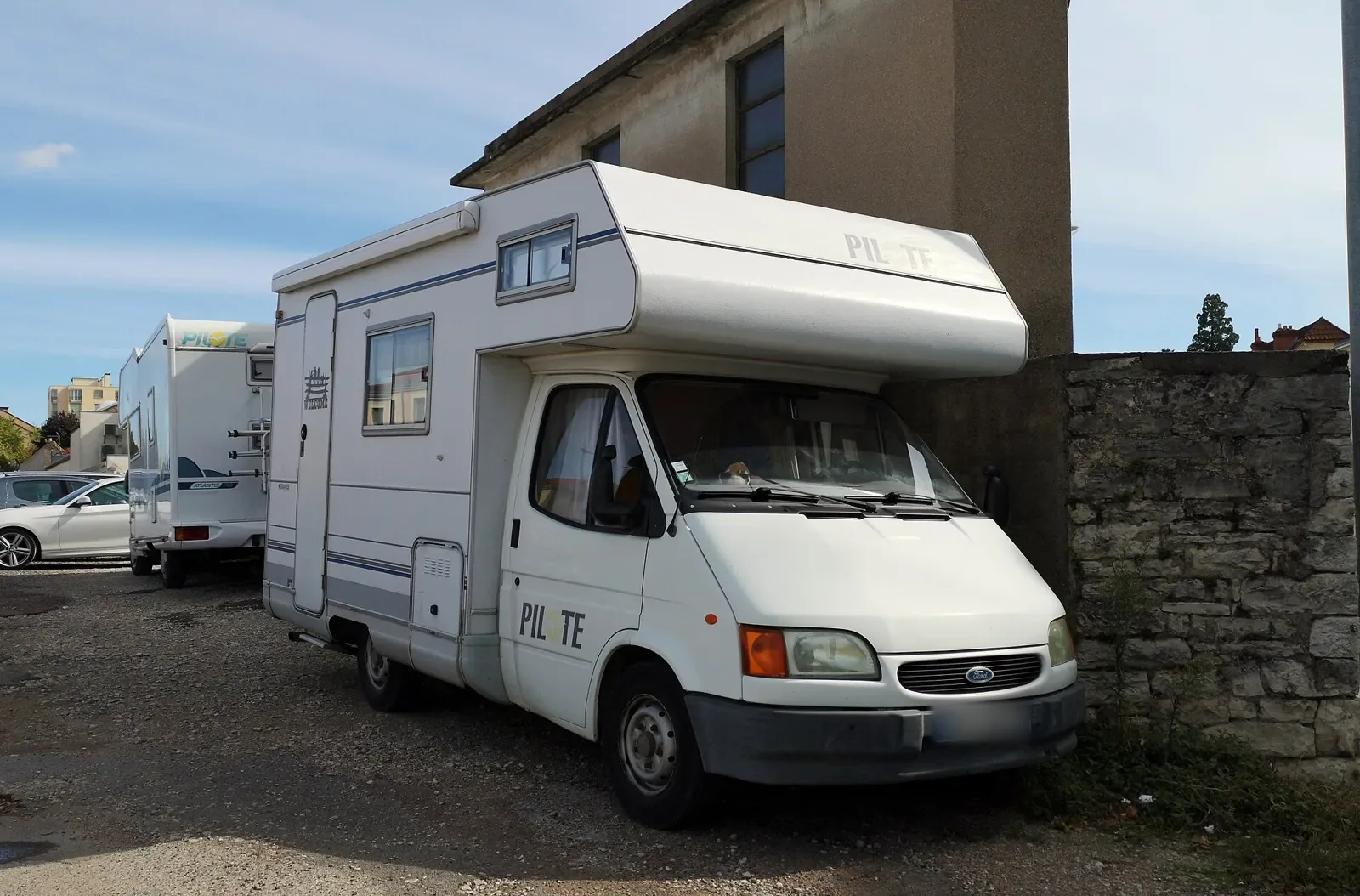
Before the registration inspection
Have the written account of the changes ready, and take documentation of the conversion — drawings, photographs and installation instructions. Weigh the finished vehicle so that you know the mass in running order and the remaining payload. Use the inspection checklist. Book the inspection within one month of finishing the conversion, or within one week if the vehicle has been laid up and is being put back on the road.
Driving licence: what may you drive?
| Entitlement | Motorhome |
|---|---|
| B | Passenger car class II with a maximum authorised mass of 3,500 kg |
| B with code 96 | A vehicle combination up to 4,250 kg, but the motorhome itself no more than 3,500 kg |
| B obtained before 1 July 1996 | A passenger car with a maximum authorised mass over 3,500 kg, if the entitlement has not been withdrawn after that date |
| C1 | A motorhome over 3,500 kg (up to 7,500 kg) |
| C1E or CE | A heavy motorhome with a trailer |
See also the Swedish Transport Agency’s pages on driving licences (English).
What’s new: B99 and 4,250 kg
The fourth driving licence directive was adopted in the EU in autumn 2025. It opens the way for a holder of a category B licence to drive a motorhome with a maximum authorised mass over 3,500 kg but no more than 4,250 kg, after training, a test, or a combination of the two. According to the Swedish government’s answer to parliamentary question 2025/26:815, the rules must be implemented by 26 November 2028 and will start to apply from 26 November 2029. What requirements will apply in Sweden is still being examined, with a proposal due by 16 July 2027.
Important. Until then, today’s rules apply. If you buy a motorhome over 3,500 kg today and your B licence was issued after 1 July 1996, you need C1.
Weight and overloading
The maximum authorised mass in the registration certificate is what determines which licence you need, and the actual mass must never exceed it. The police may prohibit continued travel if the overload is more than ten per cent. How to calculate and weigh the vehicle is covered in the guide to motorhome weight and axle loads and in the weight calculator.
Periodic inspection
A motorhome with a maximum authorised mass of up to 3,500 kg must have its first periodic inspection no later than 36 months after it was put into service, then after 24 months, and thereafter every 14 months. Heavier motorhomes have different intervals — check with the Swedish Transport Agency. Before the inspection you can use the inspection checklist. English overview: motor vehicle inspection.
Winter tyres
From 1 December to 31 March, a motorhome registered as a passenger car must have winter tyres or equivalent equipment when there are winter road conditions. The minimum tread depth is then 3 mm, but a passenger car class II with a maximum authorised mass over 3,500 kg requires at least 5 mm. Studded tyres may be used from 1 October to 15 April, or outside that period if there is, or is expected to be, winter road conditions. More in the guide to winter tyres on a motorhome. English overview: winter tyres.
Insurance and tax
A motorhome that is taxed and in use (påställd) must have compulsory third-party insurance and pays vehicle tax. When the vehicle type changes at re-registration, the basis for tax and insurance also changes, so contact your insurer before you drive the vehicle as a motorhome. You can see the vehicle tax for your specific vehicle at the Swedish Transport Agency. Also consider whether the policy covers the conversion and damp damage, because the terms differ between insurers. English overview: taxes and fees.
LPG
The LPG system must be tight and correctly installed. A regular leak test by a qualified person is recommended, and a test certificate is often requested by campsites, insurers and when travelling abroad. Follow the manufacturer’s instructions for the LPG system and use an LPG alarm. More in the guide to LPG in a campervan.
Buying a motorhome from abroad
A motorhome bought in another country and to be registered in Sweden first needs, according to the Swedish Transport Agency, an application for an origin check (fee SEK 1,240 according to the Agency’s fee list, October 2026) and then a registration inspection before it can be registered here. New vehicles from another EU country must also be reported to the Swedish Tax Agency (Skatteverket) for VAT. The exact process depends on whether the vehicle is used or new, whether it has EU type approval, and which country it comes from. Check the Swedish Transport Agency’s information on vehicle import (English) and the Swedish origin-check page before you buy, and check that the vehicle’s maximum authorised mass in the foreign documents matches what your licence allows.
Overnight stops
Sweden’s Right of Public Access (allemansrätten) applies to people, not vehicles. Where you may park and stay overnight with a motorhome or campervan is decided by traffic rules, signs and local regulations. Read more in our guide to wild camping in Sweden, or find places intended for motorhomes on our map of motorhome aires and stopovers.
Changes after registration
If you make major changes after the motorhome has been registered — for example changing the number of seats, substantially rebuilding the interior, altering the suspension or raising the maximum authorised mass — a new registration inspection may be required. Changes that affect mass, brakes, steering or seat belts should always be checked. Contact an inspection body before you make the change if you are unsure.
Documents to have in order
- Registration certificate with the correct vehicle type, maximum authorised mass and number of seats.
- The latest inspection report.
- An insurance policy that covers the motorhome and the conversion.
- An LPG test certificate, if you have LPG.
- Conversion documentation: drawings, photographs and installation instructions.
- A weighing receipt, so that you know the vehicle’s actual mass.
Frequently asked questions
What does passenger car class II mean?
A passenger car that is permanently fitted out as living accommodation. The requirements and how re-registration works are in the guide to passenger car class II.
How heavy a motorhome may I drive with a category B licence?
Up to 3,500 kg maximum authorised mass. If you obtained your B licence before 1 July 1996 you may drive heavier passenger cars, provided the entitlement has not been withdrawn after that date.
When will a category B licence cover a motorhome up to 4,250 kg?
According to the government, the new motorhome rules will start to apply in Sweden from 26 November 2029. The exact requirements have not yet been decided.
Is there a special speed limit for a motorhome?
No, not for a passenger car class II. The same speed limits apply as for other passenger cars.
Do I have to have a registration inspection if I convert a panel van into a motorhome?
Yes. If the vehicle type is to be changed to passenger car class II, a registration inspection is required, with a written account of the changes.
Which rules apply when you convert a panel van into a motorhome?
The interior must be permanently fitted, with seats, sleeping places, cooking and storage equipment, and a table. The vehicle must undergo a registration inspection within one month of the change being made, or within one week after a lay-up ends, and you provide a written account of the changes.
How often must the motorhome be inspected?
For motorhomes up to 3,500 kg: the first time after 36 months, then after 24 months, and thereafter every 14 months.
Sources
- Swedish Transport Agency, Vehicles (English) and Passenger cars, including class II (Swedish)
- Swedish Transport Agency, TSFS 2010:87 on registration inspection
- Swedish Transport Agency, Vehicle categories (PDF, Swedish)
- Swedish Transport Agency, Motor vehicle inspection (English) and the inspection rules up to 3,500 kg (Swedish)
- Swedish Transport Agency, Winter tyres (English)
- Swedish Environmental Protection Agency, The Right of Public Access (English) and the Swedish allemansrätten page
- Swedish Transport Agency, Vehicle import (English) and origin check (Swedish)
- Riksdag, answer to question 2025/26:815 on B99 for motorhomes
Last checked: October 2026. This is a summary, not legal advice.
New checklists and guides, plus reminders before winter storage and inspection. A few emails a year, nothing more.
The content is based on my own experience and the rules that applied when the text was written. Rules can change, and I am not responsible for factual errors or rule changes that affect your build or maintenance. Read the full disclaimer.

Linus Thell
Founder of Camperliv.se. Has worked with vehicles for essentially all of his adult life.
Read more about Linus →