
Contents of the guide Show ▾
Choosing the vehicle for your campervan is the single most important decision in the whole project. Everything else (the interior, electrics, insulation, how you can use the van) is built on top of this choice, and it is expensive and frustrating to regret. A van that is too small limits the build, one that is too heavy becomes illegal to drive, and one that is rusty under the surface can cost you a great deal of money before you have even started on the woodwork.
I have worked with vehicles for many years and have seen the consequences of hasty van purchases many times. Whether you want to convert a van into a campervan for weekend trips or to live in full time, this guide shows you how to think from the start: what the vehicle needs to cope with, which models actually work as a base, and, most important of all, what to check before any money changes hands.
The essentials at a glance
- Start from how you will use it, not from a nice picture. A weekend van, a summer holiday van and a full-time home make completely different demands.
- Weight is what most people regret. A finished build often weighs 600–1,000 kg (1,320–2,200 lb) more than the empty van. On an ordinary Swedish category B licence (passed after 1 July 1996) the limit is 3,500 kg (7,716 lb) gross vehicle weight, and that limit is easier to exceed than you think.
- The Sevel trio (Fiat Ducato / Citroën Jumper / Peugeot Boxer) is Europe’s most common motorhome base for good reasons: a wide body, a low step-in height and plenty of space.
- If you buy used, condition decides, not mileage. Rust, the timing belt, the clutch and the drivetrain are what cost money.
Start with the purpose: how will you use your campervan?
Before you look at a single advert, decide what the van has to do. That drives size, weight and budget more than anything else.
Checklist as PDF: Used campervan buying checklist (in Swedish). Interactive version in English: used van checklist.
- The weekend van. Two people, a couple of nights at a time, has to park like an ordinary car and be driven to work. Compact and nimble wins here: a shorter van or a VW Transporter with a pop-top roof.
- The holiday van. A family or couple on longer trips. You want standing height, a fixed bed and a proper kitchen. Most people end up with a medium-length, high-roof van.
- The full-time or off-grid home. Long stays, lots of equipment, large batteries and water tanks. Weight becomes the big challenge here, and four-wheel drive may be worth the money.
Being honest at this stage saves you from the most common mistake: buying a bigger van “just in case” and then living with higher fuel consumption, worse access and parking problems for years.
The most common base vehicles for a campervan: pros and cons
Most campervan conversions start from a large panel van. Which is the best van for a campervan depends on how you will use it, but these are the models you will come across. Here is what you need to know about each base vehicle for your build.
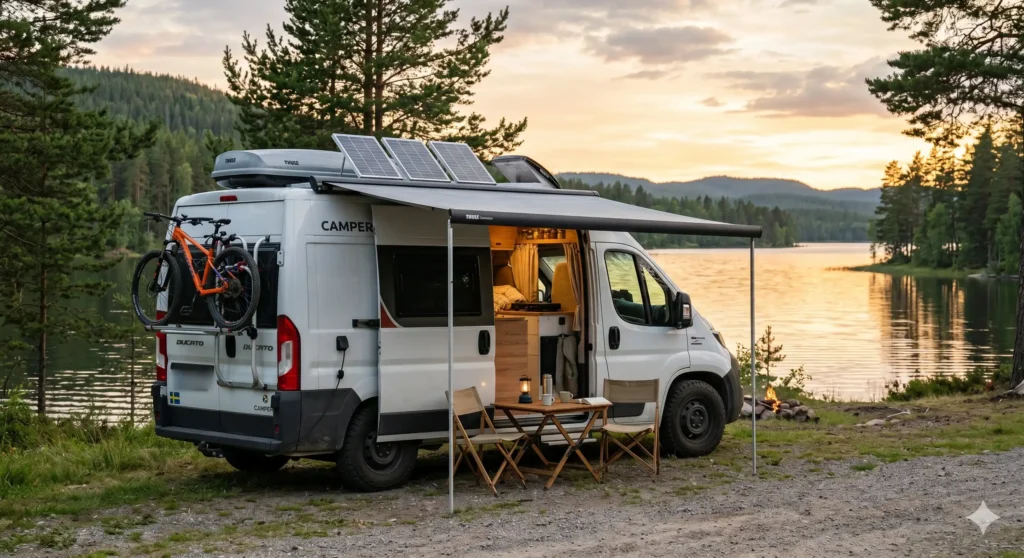
Fiat Ducato / Citroën Jumper / Peugeot Boxer (the Sevel trio)
Three names, in practice the same vehicle: they are built on the same platform and share most of the mechanics. This is by far Europe’s most common motorhome base, and it shows: spare parts are everywhere, there are ready-made interior solutions for exactly these dimensions, and the used market is huge.
Strengths: a wide body (in the wider versions you can fit a cross bed even for taller people), a low step-in height thanks to front-wheel drive, and a proven 2.3-litre diesel engine. Weaknesses: front-wheel drive can lose grip when the van is heavily loaded and you are going uphill on a loose surface. Keep an eye on the clutch and dual-mass flywheel on older examples; a judder when pulling away is a warning sign.
Read more: timing belt intervals, EGR, DPF, AdBlue and rust zones per generation are in the guide Fiat Ducato as a campervan: common faults.
Mercedes Sprinter
The premium option, and the most common base for really big, heavy builds. Available with rear-wheel drive and true four-wheel drive (4×4), which makes it a favourite for anyone who wants to get around in winter or off tarmac.
Strengths: strong, tall (full standing height in the high-roof version), good towing capacity and rear-wheel drive that keeps its grip under a heavy load. Weaknesses: more expensive to buy and service. Rust was a known problem on older model years; check the wheel arches, door edges and rear end carefully. More in Mercedes Sprinter: common faults.
VW Crafter / MAN TGE
The same van under two badges, and the most modern candidate in the class. Car-like to drive, lots of driver assistance, and available with front-, rear- and four-wheel drive (4MOTION).
Strengths: a driving feel close to a car, modern safety and a flexible drivetrain. Weaknesses: priced at Sprinter level. A smaller used market than the Sevel trio because the model is newer.
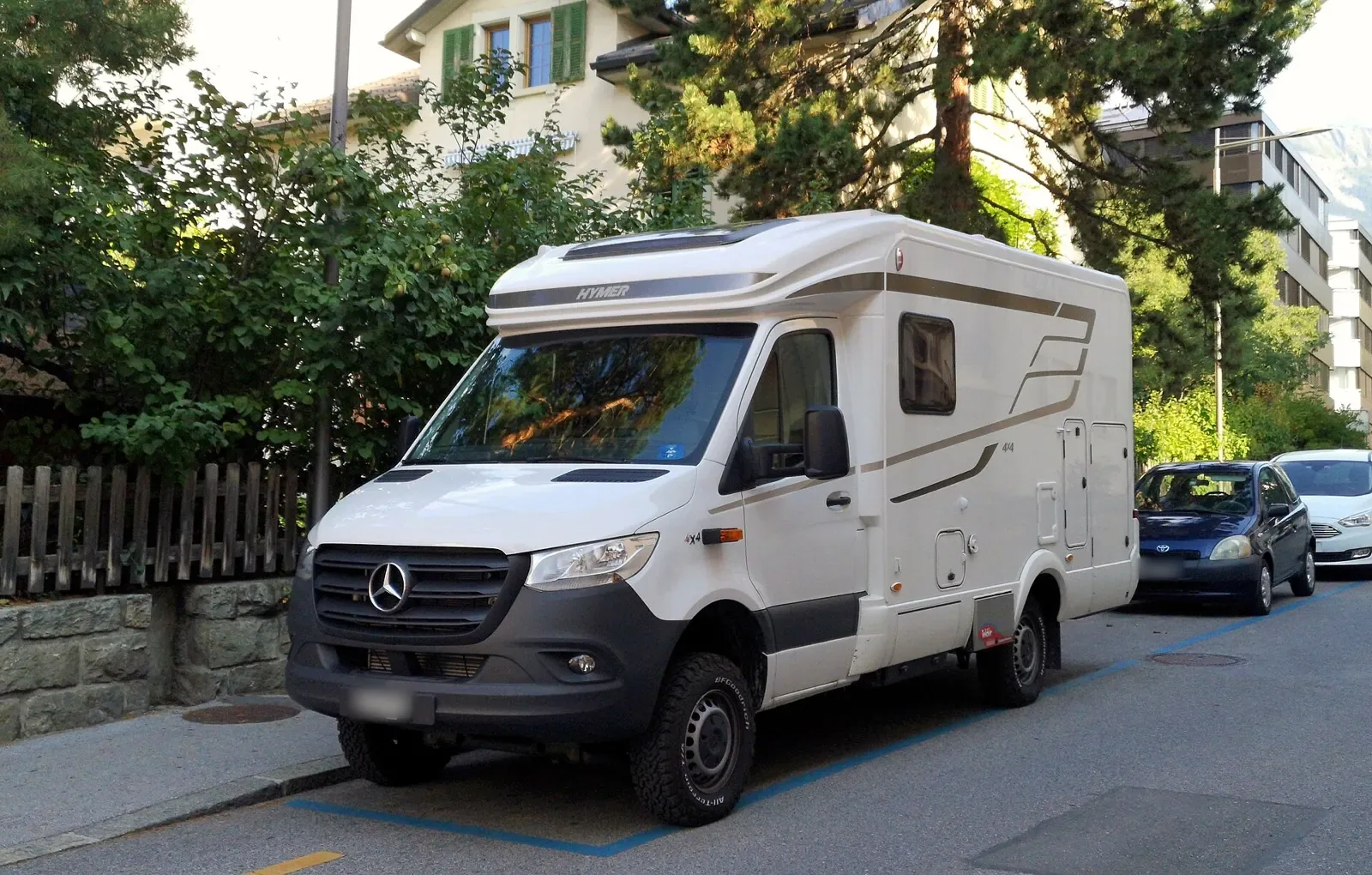
Ford Transit
Good value, good to drive, and with a dense dealer and service network. Available with front-, rear- and four-wheel drive.
Strengths: a lot of van for the money, plenty of parts and expertise. Weaknesses: check the diesel engine’s service history extra carefully, and make sure the timing belt or chain has been maintained correctly for that engine variant. More in Ford Transit: common faults.
Renault Master / Opel Movano / Nissan Interstar
Another platform sold under several badges. Good value and roomy, a good option when the budget is tight but you still want a full-size van.
Strengths: lots of space for the money, available in many length and height versions. Weaknesses: many people find the finish and driving feel a little more basic than the more expensive options.
VW Transporter (T5/T6) and compact alternatives
The iconic weekend van. A Transporter, Vito, Trafic or Transit Custom will never be a big living space, but as a nimble “micro-camper” with a pop-top roof it is hard to beat: you drive it to work during the week and camp at the weekend.
Strengths: nimble, a premium feel, excellent resale value (especially VW). Weaknesses: no standing height without a pop-top roof, and much less living space. You pay more per litre of space than in a full-size van.
Quick comparison
| Model | Size | Typical drivetrain | Standing height | Used market | Best for |
|---|---|---|---|---|---|
| Fiat Ducato / Jumper / Boxer | Medium–large | Front | Yes (high roof) | Very large | All-round, families, first build |
| Mercedes Sprinter | Large | Rear / 4×4 | Yes (high roof) | Large | Heavy builds, off-grid, winter |
| VW Crafter / MAN TGE | Large | Front/rear/4WD | Yes (high roof) | Small–medium | Modern premium |
| Ford Transit | Medium–large | Front/rear/4WD | Yes (high roof) | Large | Good-value all-rounder |
| Renault Master etc. | Medium–large | Front | Yes (high roof) | Large | Most space for the money |
| VW Transporter etc. | Small | Front | No (needs a pop-top roof) | Large | Weekends, everyday car |
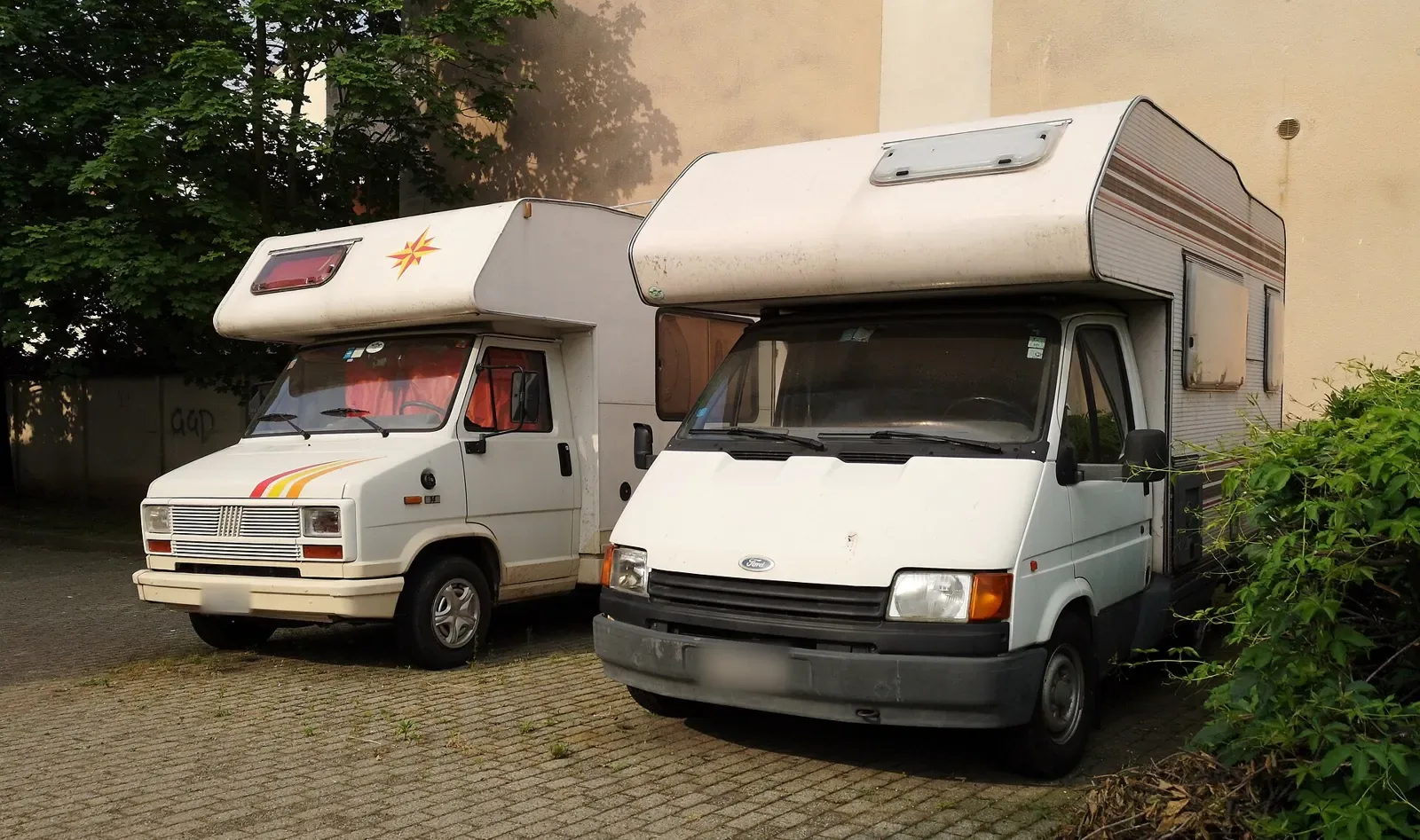
Size and roof height: length, height and headroom
Large vans are sold in length and height classes, usually L1–L4 and H1–H3. For standing height you need, in practice, a high roof (H2 or H3). With a low roof (H1), a pop-top roof is the alternative. A medium-length, high-roof van (roughly L2H2) is the usual compromise between living space and a van you can still park. Also think about where the van will be kept at home.
The codes are not standardised, so an L2H2 has different dimensions from different makers. The dimensions per make, and what the size means for the bed, weight, parking and ferries, are in the guide L1H1, L2H2 and L3H2 explained.
Front-, rear- or four-wheel drive?
The drivetrain matters more for a campervan than for an ordinary car, because your camper is basically always fully loaded.
- Front-wheel drive (most common on the Ducato family) gives a lower load floor and good grip when unladen. The downside shows when fully loaded going uphill on gravel or snow, where the front can go light and spin.
- Rear-wheel drive (Sprinter and others) keeps its grip better when the van is heavily loaded, which is an advantage precisely for a campervan that is always fully loaded.
- Four-wheel drive gives the best access and is worth considering if you really will go off-road or drive a lot in winter. It does, however, cost more to buy, in fuel and in maintenance; choose it because you need it, not for the feeling.
Weight: the decision most people regret
This is where most people make their most expensive mistake, so read this twice.

The difference between the vehicle’s mass in running order (what it weighs empty, ready to drive) and its gross vehicle weight (the maximum permitted weight) is your payload: everything you are allowed to put in, including the interior, water, LPG, batteries, passengers and luggage.
A finished build is heavier than most people think. Furniture, insulation, water (1 litre = 1 kg, about 8.3 lb per US gallon, and a full tank can weigh 100 kg / 220 lb), a battery bank, appliances and equipment easily add up to 600–1,000 kg (1,320–2,200 lb) or more. That is why so many self-builds in practice end up over their legal gross vehicle weight.
What applies to the driving licence (Swedish rules)?
- If you passed your category B licence after 1 July 1996, you may drive vehicles with a gross vehicle weight of up to 3,500 kg (7,716 lb). That is the limit you have to plan your campervan around today.
- If you passed your category B licence before 1 July 1996, you have so-called grandfather rights and may drive a passenger car class II (motorhome) regardless of its gross vehicle weight (provided the licence has not been revoked after that date).
- A common misunderstanding: B96 (extended B) does not raise how heavy a single vehicle you may drive. It applies to combinations with a trailer of up to 4,250 kg (9,370 lb). The vehicle itself is still limited to 3,500 kg.
- Coming: the EU’s fourth driving licence directive, adopted in autumn 2025, opens the way for category B holders to drive a motorhome of up to 4,250 kg (9,370 lb) after special training, a driving test or both (referred to as B99). According to the Swedish government, the rules are to apply in Sweden from 26 November 2029, and the requirements have not yet been decided. Always check the current position with Transportstyrelsen (the Swedish Transport Agency) before you rely on the 4,250 kg limit.
Driving overloaded is not a trifle. In Sweden, a vehicle’s gross vehicle weight must not be exceeded while driving (Trafikförordningen, the Swedish Traffic Ordinance, chapter 4, section 4). The on-the-spot fine rises with the percentage by which the gross vehicle weight is exceeded, from SEK 500 at 1–4% to SEK 4,000 at 35% or more (the Swedish Prosecution Authority’s regulations on on-the-spot fines, SFS 2024:1084, item 11.6, in Swedish). If the gross vehicle weight is exceeded by more than 10%, the police or a vehicle inspector must make sure the vehicle is reloaded or unloaded (Trafikförordningen chapter 14, section 16).
Conclusion: choose a base vehicle with good payload from the start (there are uprated “heavy” chassis versions), estimate how much your planned build will weigh, and keep a margin. It is much cheaper to choose the right van than to slim down a finished build.
> This is so central that it deserves its own section. See Rules and inspection for re-registration as a passenger car class II and the exact weight and dimension requirements.
How to read the registration document, weigh the van and what applies to licences and overloading is covered in the guide weight and axle loads on a motorhome (in Swedish). Work out your own build in the weight calculator.
Used or new, and what it means for your wallet
A used panel van is the most common and cheapest way in when you buy a van for your conversion. You get the most van for the money, but you also take over the vehicle’s history, and this is where my experience says you should be most alert (more on the checks below).
A new panel van gives you a warranty, a known history and a clean slate to build on, but costs considerably more and loses value in the first few years.
A used motorhome to renovate can be a shortcut if the basic build is sound, but inherited damp damage and hidden faults can end up costing more than building from scratch.
Think about the whole: vehicle cost + build cost. Don’t spend the whole budget on the van and then have nothing left for the interior. A common split is for the van to take roughly half the budget. More in the campervan build budget.
Fuel, engine and low-emission zones
Diesel dominates and will continue to for a while yet: the torque and range suit a heavy vehicle that will cover long distances.
If you plan to drive in larger cities, choose an engine with modern emissions control (Euro 6) to be ready for low-emission zones, which are becoming more numerous and stricter. A particular vehicle’s Euro class decides whether it may be driven in the stricter zones; check the current rules for the cities you plan to visit.
Electric vans (e-Transit, e-Sprinter and others) exist, but for campervan use they are still immature: the range shrinks considerably with a heavy load, and the battery eats into exactly the payload you need. The technology is coming, but for a vehicle you will drive far and live in, diesel is still the safe choice in 2026.
Checklist when buying a used panel van
This is the part almost every vanlife guide skips, and it is exactly where the most expensive faults hide. Condition decides, not mileage. A well-maintained van with 250,000 km (155,000 miles) on the clock can be a better buy than a neglected one with 120,000 km (75,000 miles).
Rust: start from underneath. In Sweden, road salt is your worst enemy. Check the underbody, wheel arches, sills, door edges and the area around the rear doors. Surface rust is manageable; rust holes in load-bearing parts are a no. Bring a torch and don’t be afraid to lie down under the van.
Timing belt or chain. Do you know when the timing belt was last changed? A belt that snaps can wreck the engine completely. A documented belt change at the right interval is worth its weight in gold; if there is none, factor in the cost straight away.
Clutch and dual-mass flywheel. Feel for judder and snatching when pulling away. A worn dual-mass flywheel is an expensive repair and common on vans that have been driven hard.
Emissions control (DPF, EGR, AdBlue). On Euro 5/6 vans, the diesel particulate filter clogs if the van has only been driven short distances. Ask how the van has been used: a delivery van in city traffic has had a harder life than a tradesperson’s van that has done motorway miles.
Drivetrain, wheel bearings and brakes. Listen for noises on the test drive and feel for play. Wear increases with weight, and your campervan will always be heavy.
Test-drive properly. Cold-start the van yourself (an engine the seller has already warmed up hides problems), drive at different speeds, go through all the gears and listen.
Check the history. Service book, number of owners, previous use. A former delivery van has many cold starts and stop-start miles behind it; it doesn’t show in the paint but you can feel it in the mechanics.
> If you want to know exactly how to rust-proof and maintain the van after you buy it, there are more detailed guides under maintenance.
The full inspection covering body, engine, electrics, LPG, damp and paperwork is in the buying checklist for a used campervan. If you plan to drill for windows and a roof fan, read rust protection when drilling first, and for the electrics: B2B chargers and smart alternators.
Common mistakes to avoid
- Buying on emotion and pictures instead of need, and then living with the wrong size for five years.
- Forgetting the weight until the build is finished and the van is illegal to drive.
- Staring at the mileage and missing rust and neglected servicing.
- Spending the whole budget on the van and not being able to afford a proper build.
- Choosing four-wheel drive you don’t need and paying for it in fuel for the rest of your ownership.
Once the van is built comes the next step: read about re-registering the van as a passenger car class 2 and the rules for building a campervan (Swedish rules).
Summary: how to choose the right vehicle for your campervan
Start with the purpose, not the adverts. Decide how you will actually use the van, work backwards to how much space and payload you need, and choose a model with a large used market and good parts availability if it is your first build. The Sevel trio (Ducato/Jumper/Boxer) is a safe first choice for most people. Keep a very close eye on weight, so that the finished build stays within your licence. And when you have found the right van: spend an hour under it with a torch before you pay. It is the cheapest hour of the whole project.
Frequently asked questions
What is the best van for a campervan?
For most people, the Fiat Ducato (and its sisters the Citroën Jumper and Peugeot Boxer) is the safest choice: a wide body, a low step-in height, a huge used market and plenty of ready-made solutions. If the build will be heavy or driven a lot in winter, a Mercedes Sprinter with rear- or four-wheel drive is a strong alternative.
Which van should I choose for a motorhome conversion?
Start from how you will use it. For standing height and a fixed bed you need a medium-length, high-roof van (roughly L2H2). If you want a nimble everyday and weekend vehicle, a smaller van with a pop-top roof is enough. Most important of all: choose a van with enough payload for the build you are planning.
How much does a finished campervan weigh?
It varies, but expect the build itself to add 600–1,000 kg (1,320–2,200 lb) or more on top of the vehicle’s mass in running order. That is why payload is one of the most important figures to check before you buy.
Can I drive a campervan on an ordinary category B licence?
Under Swedish rules, yes, as long as the gross vehicle weight stays within 3,500 kg (7,716 lb) (for licences passed after 1 July 1996). A new entitlement raising the limit towards 4,250 kg (9,370 lb) is on its way through the EU driving licence directive but is not yet in force in Sweden; check the current position with Transportstyrelsen. Rules in other countries may differ.
Is it better to buy new or used?
Used gives you the most van for the money but requires you to check its condition carefully. New gives you a warranty and a known history at a higher price. Condition, not mileage, decides whether a used purchase is a good one.
Does mileage matter most when buying used?
No. A well-maintained van with high mileage can be a better buy than a neglected one with low mileage. Rust, timing belt changes, the clutch and the service history say more about the vehicle’s real condition.
By Linus Thell, founder of Camperliv.se. Vehicle advice from someone with long experience of cars.
Read on: Rules and inspection · Build guides · Electrics and off-grid · Maintenance
New checklists and guides, plus reminders before winter storage and inspection. A few emails a year, nothing more.
The content is based on my own experience and the rules that applied when the text was written. Rules can change, and I am not responsible for factual errors or rule changes that affect your build or maintenance. Read the full disclaimer.

Linus Thell
Founder of Camperliv.se. Has worked with vehicles for essentially all of his adult life.
Read more about Linus →