Contents of the guide Show ▾
Quick answer In a modern van with a Euro 6 engine, the alternator often lowers the charging voltage once the starter battery is full, to save fuel. A simple split-charge relay is then not enough to charge the leisure battery properly. A B2B charger (battery-to-battery, also called a charging booster) takes current from the starter battery and charges the leisure battery at the right voltage and with the right charging profile, whatever the alternator is doing. If you have a lithium battery (LiFePO4), a B2B charger is essential in practice.
This guide explains how charging works in a campervan, why “smart” alternators cause problems, how to choose the size of the B2B charger and how to install it safely with the right cable size and fuses. It is written for anyone building their own van or wondering why the leisure battery never gets fully charged while driving.
The essentials at a glance
- Two batteries, two jobs: the starter battery starts the engine; the leisure battery runs the fridge, lights, heater and chargers. They should not drain each other.
- Smart alternator = varying voltage. Charging can drop to close to resting voltage while you drive. An ordinary relay then charges poorly.
- A B2B charger solves this and also protects the starter battery by only charging when the engine is running.
- Size: 20–30 A is enough for many smaller systems; 40–60 A suits larger lithium batteries. The limit is often the alternator and the cables.
- Fuse every positive cable close to the battery and choose the cable size by current and length.
The basics: how 12 volts works in a campervan
Most panel-van conversions have a 12 volt system in the living area. It consists of one or more leisure batteries, charging sources and loads. There are usually three charging sources: the vehicle’s alternator while driving, solar panels on the roof and mains hook-up through a charger when you are at a campsite.
| Term | What it means | Example |
|---|---|---|
| Ah (amp-hours) | The battery’s capacity at a given voltage | 100 Ah at 12 V |
| Wh (watt-hours) | Energy: voltage multiplied by capacity | 100 Ah × 12.8 V ≈ 1,280 Wh |
| A (amps) | The current flowing right now | A compressor fridge often draws 3–5 A while running |
| Usable capacity | How much you can take out without damaging the battery | AGM about half, LiFePO4 most of it |
Always start with an energy budget: list your loads, how many amps they draw and how many hours a day. The total in Ah per day decides how big a battery and how much charging you need.
Why smart alternators cause problems
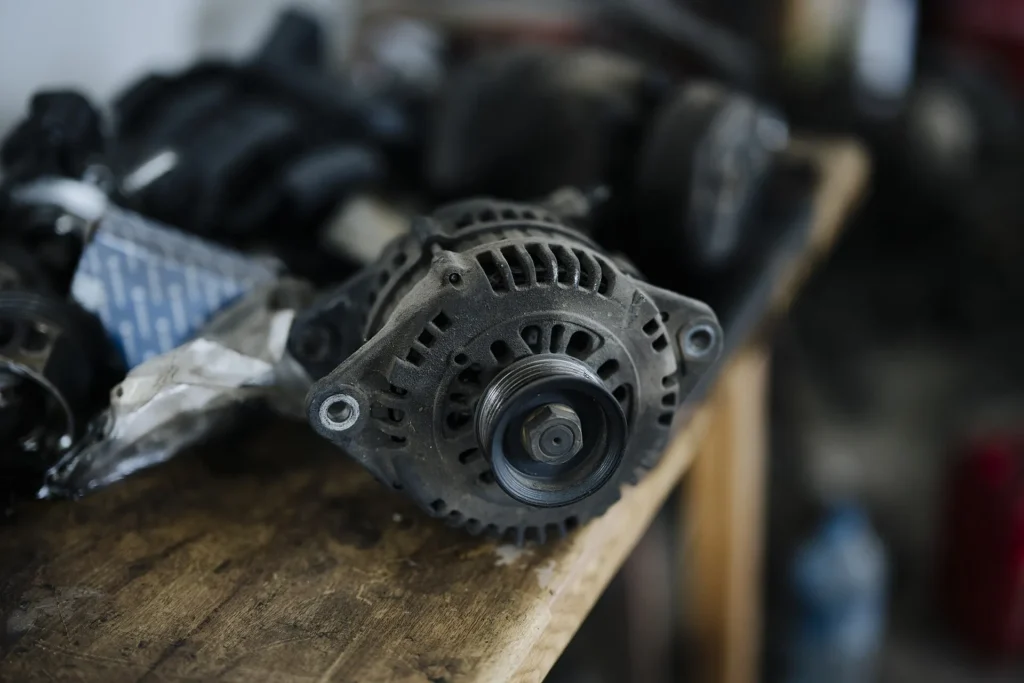
Older vehicles charge at a fairly constant voltage, around 14 volts, as long as the engine is running. There, a simple split-charge relay that links the starter and leisure batteries while the engine runs works fine.
Newer vehicles, especially those with Euro 6 engines, often have a controlled or “smart” alternator. The vehicle’s electronics monitor the starter battery and lower the alternator voltage when the battery is full, to cut fuel consumption. Under braking, the voltage may instead be raised to recover kinetic energy. According to the charger maker Victron, the voltage from a smart alternator can vary between roughly 12.5 and 15 volts in a 12 volt system. For the leisure battery, that means the charging voltage jumps up and down and is often too low to fill the battery.
Common mistake Fitting an ordinary relay in a Euro 6 van and assuming the leisure battery gets fully charged while driving. Measure the voltage at the leisure battery during a longer drive. If it mostly sits around 12.5–13 volts, the battery is barely charging.
Some B2B chargers have a special mode for smart alternators. They start charging using a signal from the ignition (D+ or ignition live) instead of looking only at the voltage, because the voltage no longer tells you whether the engine is running.
What does a B2B charger do?
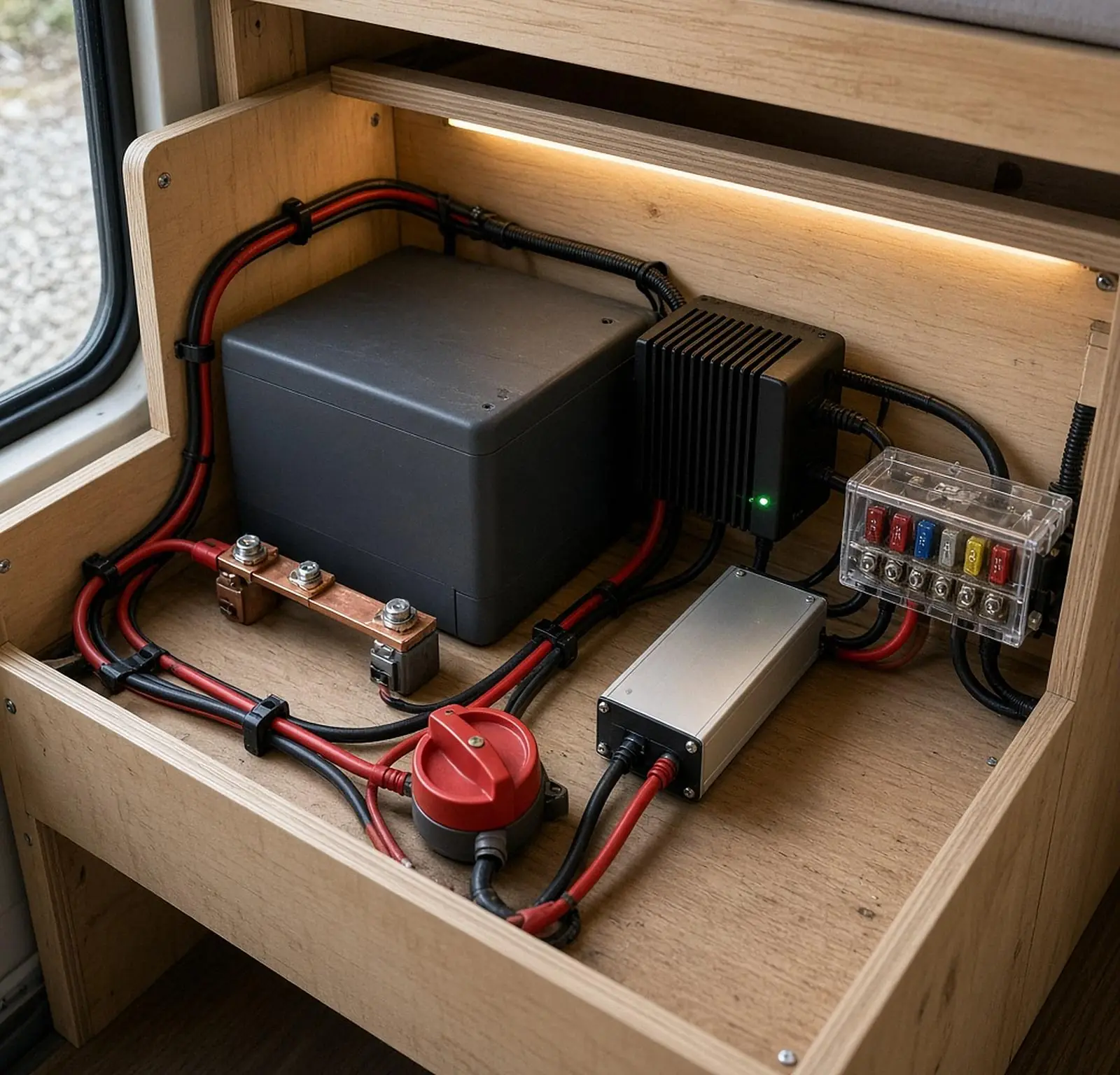
A B2B charger (DC-DC charger) takes the voltage from the starter battery, converts it and charges the leisure battery in stages, in the same way as a good mains charger: bulk, absorption and float. You set the charging profile to suit the battery type.
- The right charging profile for AGM, gel or lithium, independent of the alternator voltage.
- Limited current so that the alternator and cables are not overloaded.
- Protection of the starter battery, because the charger stops when the voltage drops or the ignition is switched off.
- Compensation for voltage drop in long cables from the engine bay to the living area.
What size B2B charger do I need?
| Leisure battery | Typical B2B size | Comment |
|---|---|---|
| AGM 90–120 Ah | 20–30 A | AGM does not accept high current for long; a larger charger gains little |
| LiFePO4 100–200 Ah | 30–50 A | Lithium accepts high current, so the size decides the charging time |
| LiFePO4 200–300 Ah or more | 50–60 A, sometimes two chargers | Check the alternator’s capacity and the vehicle maker’s recommendations |
The table gives rough guide values. Always read the battery and charger manuals, and check what the vehicle’s alternator and wiring can handle.
Worked example: a 30 A charger gives, in theory, about 30 Ah per hour of driving. With an energy budget of 60 Ah per day you need roughly two hours of driving to cover the day, not counting solar.
AGM or lithium (LiFePO4)?
AGM is cheaper, copes better with charging in the cold and is straightforward, but should not be discharged by more than about half if it is to last. LiFePO4 weighs less, can be discharged much more deeply and accepts charge quickly. It does, however, need the right charging profile, a built-in or separate BMS (battery management system) and protection against charging below freezing. Many lithium batteries cut off charging below freezing or have built-in heating, which matters in a Swedish winter. More in lithium or AGM in a motorhome.
Tip Measure, don’t guess. A simple battery monitor with a shunt shows exactly how many amps are going in and out. It is the quickest way to see whether charging works and where the current is going.
Installation: cables, fuses and placement
The B2B charger is mounted close to the leisure battery. A positive cable runs from the starter battery, fused close to the starter battery, and a short cable runs from the charger, fused close to the leisure battery. The negative cable should be as heavy as the positive and run to the leisure battery’s negative terminal or to an approved earth point according to the charger’s manual.
Cable size
Cable size is chosen by current and cable length, because voltage drop increases with length. The round trip counts, meaning both positive and negative. Manufacturers’ manuals include tables. We play it safe and allow a voltage drop of no more than 0.15 V: a 30 A charger then needs about 16 mm² (nearest AWG: 4 AWG) with 2 m (6.5 ft) of cable one way, and 35 mm² (1 AWG) with 4 m (13 ft); a 50 A charger needs 25 mm² (2 AWG) and 50 mm² (1/0 AWG) respectively. With a 3% voltage drop, thinner cable is enough (6 mm² and 16 mm², or 8 AWG and 4 AWG, for 30 A), but we round up for safety and for efficient charging. Run the numbers for your own van in the cable size calculator. If in doubt, choose one size too heavy rather than too thin.
AWG sizes are the nearest commonly sold size with at least the same copper area as the metric size. Metric and AWG sizes do not match exactly; the mm² value is the one we have calculated.
Fuses
- Fuse every positive cable as close to the battery as possible. The fuse protects the cable against fire in a short circuit.
- The fuse rating is chosen for the cable and the charger’s maximum current, according to the manual.
- Use fuse holders that can withstand vibration and are protected against damp.
Routing
- Use rubber grommets and rust-proof drilled holes in the bodywork. See the guide to rust protection when drilling (in Swedish).
- Secure the cables properly and keep them away from the exhaust and moving parts.
- Crimp cable lugs with the right tool and protect them with heat-shrink.
- Strap the batteries down firmly. A battery that breaks loose in a crash is dangerous.
Solar and mains hook-up as a complement
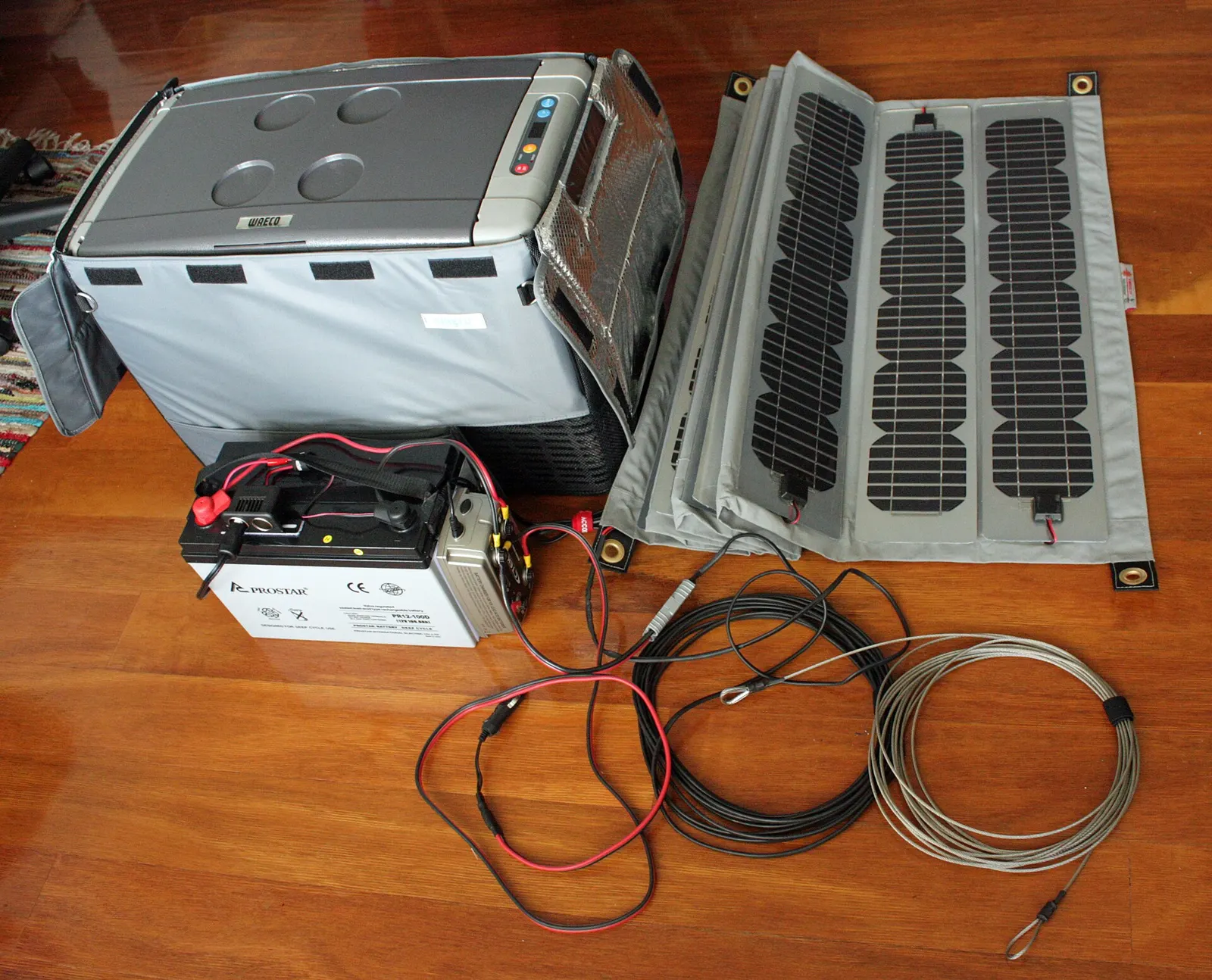
The B2B charger covers charging while you drive. When you are parked, solar and mains hook-up take over. Solar panels are connected through an MPPT controller, which gets more energy out than a simple PWM controller, especially at high panel voltage. In Sweden, solar panels give a lot in summer but little in the winter half of the year, so do not count on the sun between November and February. More in how much solar you need and choosing an MPPT controller.
Mains hook-up (230 volts) is connected to a battery charger and possibly to sockets in the living area. Under Swedish rules you do not need an electrician to install 230 V in a motorhome or campervan; that requirement applies to buildings. 230 volts can still kill. If you are unsure, have someone who knows electrics look over the 230 volt part. Use an RCD and connectors made for vehicles and camping.
Troubleshooting: the leisure battery does not charge while driving
- Measure the voltage at the starter battery with the engine running. If it is low, the alternator is regulating down. That is normal for a smart alternator.
- Check the signal to the B2B charger (D+ or ignition). Without a signal, many chargers will not start in smart-alternator mode.
- Check the fuses on both sides of the charger.
- Measure the voltage drop across cables and connections under load. Warm cable lugs or a large voltage drop mean a poor connection or a cable that is too thin.
- Check the charging profile so that it matches the battery type.
- Check the lithium battery’s BMS. It may have stopped charging because of cold or high current.
More steps are in the guide to a motorhome battery that keeps going flat.
Don’t forget the weight
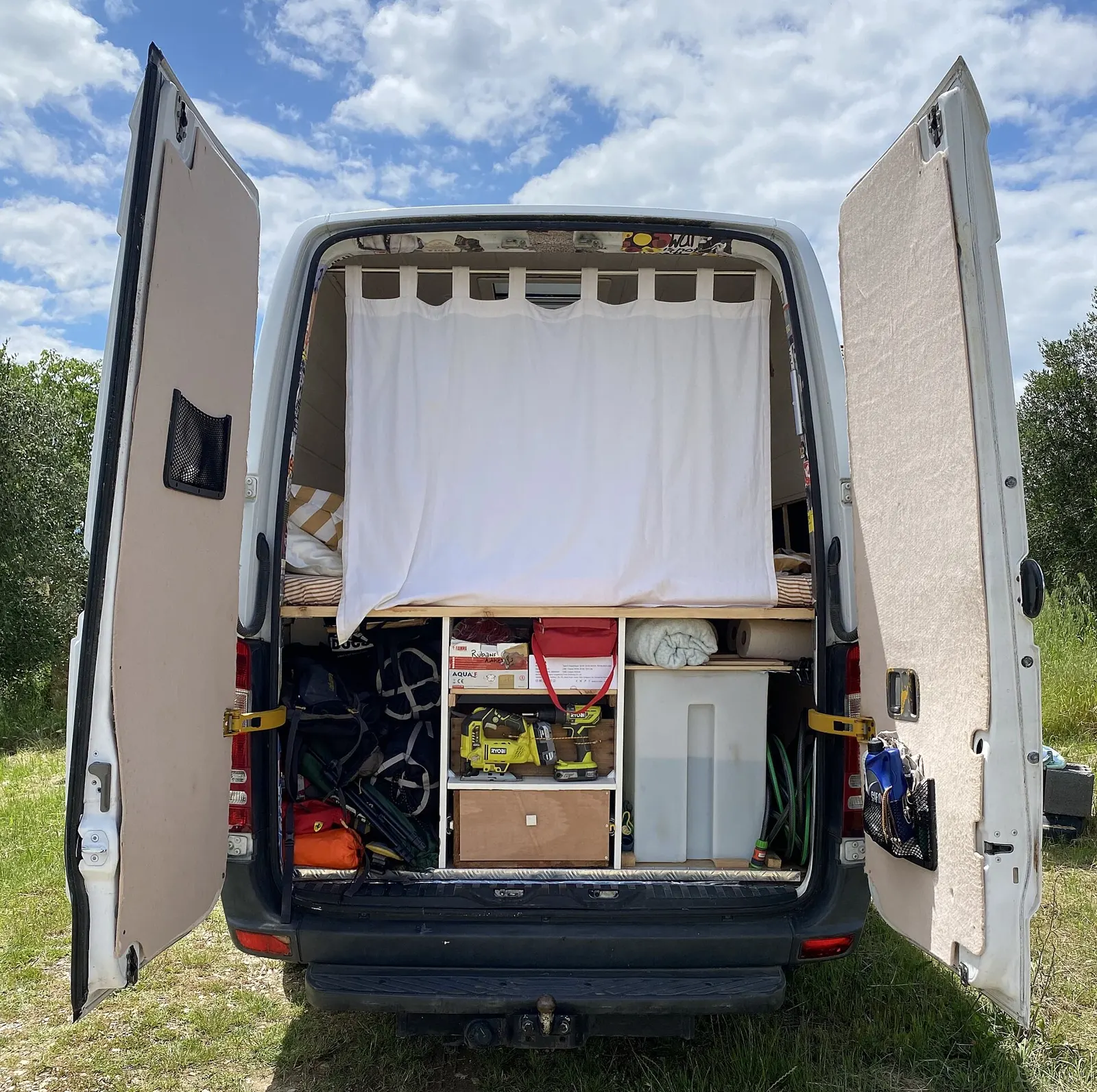
Batteries, chargers and cables add weight. Two large AGM batteries can weigh over 50 kg (110 lb), while the lithium equivalent weighs about half. Add everything up in the weight calculator before you buy, and read more in the guide to weight and axle loads (in Swedish).
Read also: the full picture in campervan electrical system, how much solar you need and when the battery keeps going flat.
Work it out yourself: the DC-DC charge time calculator shows how long the B2B charger needs.
Is the charger part of a campervan conversion? Read about the rules for building a campervan (Swedish rules) before you start.
Frequently asked questions
Do I need a B2B charger in my motorhome?
If the vehicle has a smart alternator (common in Euro 6 vehicles) or you have a lithium battery, yes, in most cases. In older vehicles with a steady charging voltage and an AGM battery, a split-charge relay may be enough.
What is a smart alternator?
An alternator controlled by the vehicle’s electronics that lowers the charging voltage when the starter battery is full, to save fuel. As a result, the leisure battery charges poorly through an ordinary relay.
What size B2B charger should I have?
As a rough guide, 20–30 A for AGM and smaller lithium batteries, and 30–60 A for larger lithium batteries. The limit is often the alternator and the cables, so follow the manufacturer’s recommendations.
Can the B2B charger drain the starter battery?
A correctly installed B2B charger only charges when the engine is running or the ignition is on, and stops when the voltage drops. That is why it protects the starter battery better than a simple relay.
Can I install the electrics in my motorhome myself?
Under Swedish rules, yes. You do not need an electrician to install electrics in a motorhome, neither for 12 nor for 230 volts; that requirement applies to buildings. Rules may differ in your country. Do the 12 volt work carefully, with the right cables and fuses. 230 volts can be lethal, so use an RCD and, if you are unsure, have someone who knows electrics look over that part.
Can a lithium battery be charged in the cold?
LiFePO4 should normally not be charged below freezing. Choose a battery with low-temperature protection or built-in heating, or place the battery in the heated part of the vehicle.
Sources
- Victron Energy, Orion-Tr Smart DC-DC Charger manual (example of smart-alternator mode, cable size and fuses)
- Victron Energy, Automatic engine shutdown detection (how the charger detects a smart alternator)
Last checked: October 2026. The values are approximate guide values. Always follow the manuals for your vehicle, charger and battery.
New checklists and guides, plus reminders before winter storage and inspection. A few emails a year, nothing more.
The content is based on my own experience and the rules that applied when the text was written. Rules can change, and I am not responsible for factual errors or rule changes that affect your build or maintenance. Read the full disclaimer.

Linus Thell
Founder of Camperliv.se. Has worked with vehicles for essentially all of his adult life.
Read more about Linus →