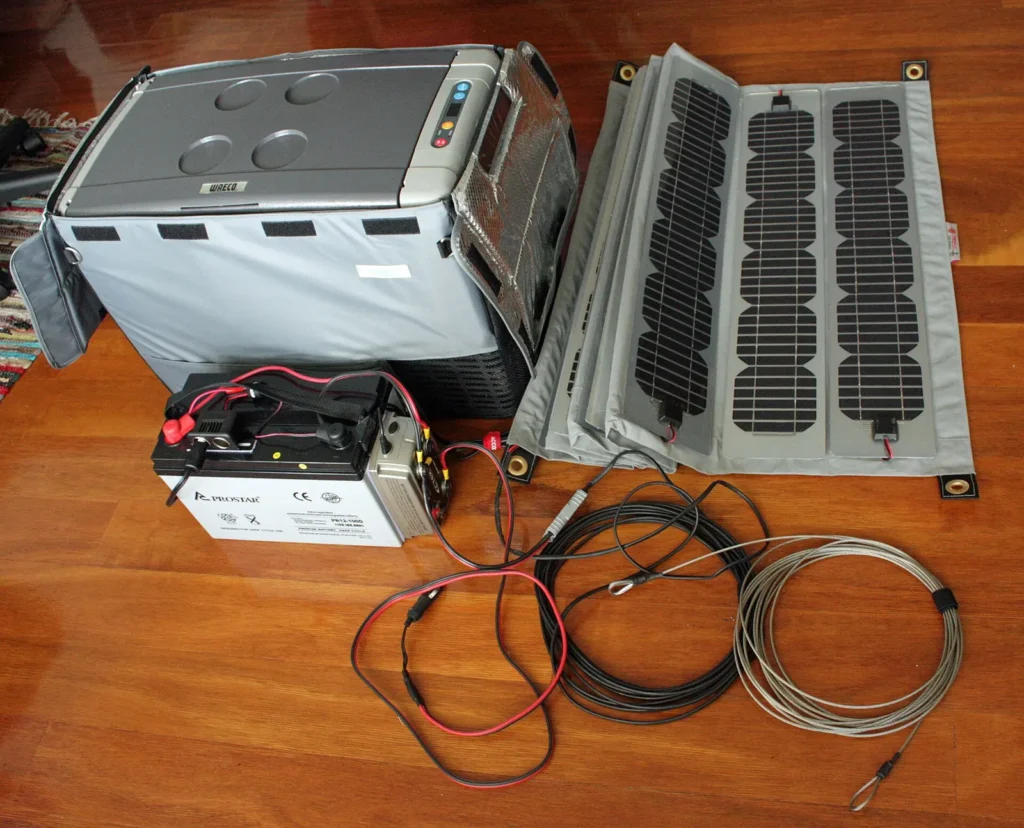
Contents of the guide Show ▾
Quick answer How much solar you need depends on your daily consumption and the time of year you travel. Work out how many amp-hours you use per day, and size the panels so that they put that back on a normal day in the season you use the van most. For summer trips in Sweden, one panel that fits on the roof of a panel van is often enough. In the winter half of the year solar gives very little, and you then need charging from the alternator or mains hook-up.
The figures for sun and seasons below are for Sweden. Further south you get more sun in winter; use the PVGIS tool mentioned below for where you will be.
The essentials at a glance
- Start from your consumption, not from how much fits on the roof.
- The sun’s contribution varies hugely between summer and winter in Sweden.
- An MPPT controller captures more energy than a simple PWM controller, especially in cold weather and weak light.
- Shading part of the panel can cut output sharply.
- Roof mounting means holes or adhesive in the roof, and doing it wrong leads to rust and leaks.
How to work it out
- Daily consumption: add up current multiplied by hours for every load; see the electrical system guide. Example: 50 Ah per day.
- Convert to watt-hours: 50 Ah × 12.8 V ≈ 640 Wh per day.
- Estimate the sun hours: how many “peak sun hours” the panel gets per day varies with season, location and weather. Use a tool such as the European Commission’s PVGIS for your location and month.
- Allow for losses: angle, heat, dirt, shade and the controller mean that real output is lower than the panel’s rated power multiplied by sun hours. A margin of 20–30 percent is reasonable.
- Panel size: Wh per day ÷ (sun hours × efficiency). With 640 Wh, 4 peak sun hours and 75 percent, that gives about 210 W.
Tip PVGIS is a free tool from the European Commission’s Joint Research Centre. You choose the location, the panel’s tilt and direction, and get an estimated output per month. For a flat panel on the roof, choose a tilt of 0 degrees.
The season matters most
| Period | Solar contribution in Sweden | What it means |
|---|---|---|
| May–August | High, long days | Often self-sufficient with the right sizing |
| March–April and September | Medium | Complements charging from the alternator |
| October–February | Very low, especially in the north | Maintenance charging, not running the van |
Always check PVGIS for your location, because the difference between southern and northern Sweden, and between Sweden and other countries, is large.
Checklist as PDF: Electrical system checklist (in Swedish). All checklists
Controller: MPPT or PWM
An MPPT controller constantly adjusts to the panel’s best operating point and can convert a higher panel voltage into charging current. That gives more energy than a PWM controller, especially when the panel voltage is much higher than the battery’s. Choose the controller by the panels’ maximum open-circuit voltage (Voc), with a margin for cold weather, because the voltage rises when it is cold. Always check the controller’s data sheet. How to calculate it step by step is in the guide MPPT controller for a motorhome: how to choose.
Fitting on the roof
- Mounts: bonded spoiler mounts or rails. Follow the adhesive maker’s instructions for cleaning and primer.
- Cable entry: a roof cable entry gland, sealed and with rust protection on the edge of the hole. Read rust protection when drilling (in Swedish).
- Fuse: fuse the cable between the controller and the battery close to the battery.
- Weight: panels, mounts and cables count against the payload. See weight and axle loads (in Swedish).
- Roof height: check the overall height after fitting, for example for garages and ferries.
The practical steps are in fitting a solar panel on a motorhome.
The solar panels are not charging
Check the controller’s display or app: does it show panel voltage? If not, look for loose connectors, blown fuses and damaged cable. If it shows panel voltage but no charging current, the battery may be full, the controller may be set to the wrong battery type, or a lithium battery’s BMS may be blocking charging in the cold. More steps are in the battery troubleshooting guide.
Three example systems
The examples show the calculation for three typical users. The figures are assumptions to illustrate the method, not measurements. Replace them with your own consumption and PVGIS values for your location.
| User | Assumed consumption | Assumed peak sun hours (summer) | Approximate panel size |
|---|---|---|---|
| Weekend trips, cool box, LED, phone | 25 Ah/day (about 320 Wh) | 4 | about 100–120 W |
| Holidays, compressor fridge, pump, heater now and then | 50 Ah/day (about 640 Wh) | 4 | about 200–220 W |
| Remote working with a laptop and inverter | 100 Ah/day (about 1,280 Wh) | 4 | about 400–450 W, plus B2B charging |
The last example shows why roof space often becomes the limit. On a short panel van there is rarely room for more than a couple of panels, and charging from the alternator while driving then becomes decisive. Read more in the guide to B2B chargers.
The battery must match the panels
Solar panels only charge when the sun is shining, but consumption goes on around the clock. The battery therefore has to store at least one day’s consumption, and preferably more to get through cloudy days. A larger battery without enough charging will never get full, though. Lead-acid batteries are particularly harmed by often sitting half charged, while lithium batteries cope better. See the electrical system guide for sizing the battery.
Rigid or flexible panels
| Rigid framed panel | Flexible panel | |
|---|---|---|
| Mounting | Mounts or rails, air under the panel | Bonded directly to the roof |
| Cooling | Better, giving higher efficiency in heat | Worse, gets hot against the roof |
| Weight and height | Heavier and taller | Lighter and lower |
| Lifespan | Normally longer | Normally shorter; check the warranty |
Warning Solar panels produce voltage as soon as light hits them. Cover the panel or disconnect it when you work on the cables, and always connect the battery to the controller before the panel if the manufacturer says so.
Work it out yourself: the solar calculator shows how much solar energy a panel gives per month.
Building your own electrical system? The rules for building a campervan cover inspection and weight (Swedish rules).
Frequently asked questions
How much solar does a motorhome need?
It depends on daily consumption and the season. Work out consumption in watt-hours and divide by sun hours and efficiency. For summer use, one or two panels on a panel van are often enough.
Is 200 W of solar enough?
For moderate consumption in the summer half of the year, 200 W can be enough. In the winter half of the year it rarely is, and you then need other charging.
Do solar panels charge in winter?
A little. They can keep a battery topped up, but rarely give enough to run the van between October and February in Sweden.
Do I need an MPPT controller?
It is recommended. MPPT captures more energy than PWM, especially with a higher panel voltage.
Do I have to drill into the roof?
Not for the mounts if you bond them, but the cable usually needs an entry gland. Rust-proof the edge of the hole and seal it carefully.
Sources
- European Commission, Joint Research Centre, PVGIS: photovoltaic output calculator
- Victron Energy, Solar charge controllers (MPPT)
Last checked: October 2026. The worked example is an example, not a measurement.
New checklists and guides, plus reminders before winter storage and inspection. A few emails a year, nothing more.
The content is based on my own experience and the rules that applied when the text was written. Rules can change, and I am not responsible for factual errors or rule changes that affect your build or maintenance. Read the full disclaimer.

Linus Thell
Founder of Camperliv.se. Has worked with vehicles for essentially all of his adult life.
Read more about Linus →